AI building a financial model but keeping trust! Episode #14 of Finance Lab – we test the latest with Claude, GPT, Grok and Gemini
Published on :
The short answer · Updated 13 November 2026
In our 12 November 2026 AI financial modelling test, eight AI builds and two human modellers worked from the same brief: a 60-month SaaS 3-way model with a cap table and a convertible note. The best AI, Claude Fable 5.2 running EXL Cloud skills, scored 63/80 against human scores of 66 and 68, and matched revenue and EBITDA to 99.7%. No AI build passed all three accuracy tests on equity IRR, closing cash and net assets, so every AI-built model still needs a human review backed by deterministic checks.
63/80
Best AI score: Claude Fable 5.2 with EXL Cloud skills. Humans scored 66 and 68.
99.7%
Operating accuracy (revenue and EBITDA) against the human models
6.0%
Balance sheet accuracy at December 2030 for the same Claude builds
0 of 8
AI builds that passed all three accuracy tests
Revenue was right to the cent. The balance sheet was 6% accurate. The equity IRR landed anywhere between 14% and 25%, against a human answer of about 21%.
That is the fifth case study in our AI financial modelling evaluation. One brief, eight AI builds across Claude, GPT (in Copilot), Gemini and Grok, and two human reference models: mine and Craig Hatmaker’s.
I presented the results at Future of Finance Lab session 14, Speed-to-Trust, with Maarten Bessems of ExcelAnalyzer. AI now builds faster than anyone can review, so the bottleneck has moved from the build to the review. This post covers what the AI got wrong and how to check its work.
Watch the session replay
Future of Finance Lab session 14, Speed-to-Trust: checking AI-built models live and post-build, with Lance Rubin and Maarten Bessems.
Key terms
AI financial modelling Using AI tools such as Claude, GPT, Gemini or Grok to build, review or extend financial models, from revenue builds to fully integrated 3-way models.
Big Blind The AI builds the full model from the written brief alone, with no formula map or structure to follow.
Small Blind The AI rebuilds a stripped model from its formula map, the formula structure of a human-built solution.
Skilled vs cold A skilled run gives the AI EXL Cloud modelling skills, which are structured instructions and guardrails. A cold run uses the vendor’s AI with no skills.
Quality score Eight factors (confidence, complexity, structure, flexibility, validations, dashboards, automation and fit) scored out of 10 each, for a maximum of 80, with caps when the audit finds a killer flaw.
Accuracy tests Three output checks against the two human models: equity IRR, closing cash and net assets at December 2030.
Speed-to-trust The time between an AI finishing a model build and a human being able to rely on it.
AI in financial modelling means using AI tools such as Claude, ChatGPT, Gemini or Copilot to help plan, build, check and explain a spreadsheet financial model. It speeds up the first draft, formula writing and documentation. It does not replace the modeller’s judgement.
The key difference is how each behaves. A spreadsheet formula is deterministic: the same inputs give the same answer every time. AI is probabilistic: the same prompt can produce a different model on each run. AI is not a calculator, so human review is not optional. It is the control framework.
That is why every AI-built model needs validation checks, a balance sheet that balances and a modeller who understands the logic before anyone relies on it. In our November test, revenue was right to the cent but the balance sheet was only 6% accurate.
How is AI used in financial modelling today?
The practical uses fall into five areas, and each still needs a qualified reviewer.
First-draft structure: laying out the sheets, assumptions register and period table from a written brief.
Formulas: suggesting formulas, explaining what an existing formula does and proposing simpler alternatives.
Data preparation: mapping trial balance and accounting system exports into a model-ready layout. Clean data comes first: you cannot automate a mess.
Checking: scanning for errors, tracing why a balance sheet does not balance and testing scenarios. Expect some false positives.
Documentation and commentary: writing model notes, assumption registers and first-draft variance commentary from the outputs.
Human oversight remains essential for linking all three financial statements, sign conventions, circular references, presentation standards and the commercial judgement on whether assumptions are reasonable.
Can AI build a financial model in 2026?
Yes, but not one you should rely on without review. In our November test the best AI build scored 63/80, three points below the lowest human score, and none of the eight AI builds matched the human models on all three accuracy tests.
Practitioners agree. None of the 63 members of the Financial Modeling Institute’s Global Leaders Council, which I sit on, would rely on an AI-built model without human review.
Case Study 5 · 12 November 2026
Quality score after audit caps, and accuracy tests passed
Build
Quality (out of 80)
Accuracy tests
Human: Craig HatmakerReference model · Excel
68
Reference
Human: Lance RubinReference model · Excel
66
Reference
Claude Fable 5.2Skilled · Claude app · Big Blind
63
0 of 3
Claude Opus 5.5Skilled · Claude app · Big Blind
60
0 of 3
Gemini (Thinking)Cold · Gemini web app · Big Blind
43
0 of 3
GPT-6.1 SolCold · Copilot in Excel · Small Blind
35
2 of 3IRR returned #NUM!
Claude Fable 5.2Skilled · Claude app · Small Blind
34
0 of 3Errors when opened in Excel
Claude Opus 5.5Skilled · Claude app · Small Blind
34
0 of 3Errors when opened in Excel
GPT-6.1 SolCold · Copilot in Excel · Big Blind
23
0 of 3No statements built
Grok 4.5 FastCold · Grok web app · Big Blind
23
0 of 3
Accuracy tests compare equity IRR, closing cash and net assets with the two human models (IRR 20.7% to 21.1%, closing cash ($1.88m) to ($2.14m), net assets $3.58m to $3.61m). Source: comparison model file v1.203, 47 of 47 validation checks passing.
Which AI model is best for financial modelling?
Claude Fable 5.2 with EXL Cloud skills scored highest at 63/80, followed by Claude Opus 5.5 at 60. The harness moved the score more than the model name did. The same two Claude models scored 34 when rebuilding from a formula map, and the cold tools scored 23 to 43.
Both Claude Big Blind builds passed every deterministic audit check: balance sheet balanced and cash tied in all 60 months, zero formula errors and no forecast hardcodes. Gemini (Thinking) was the best cold build at 43/80.
The Small Blind rebuilds show why the environment matters. Both Claude rebuilds matched the humans in their own cloud engine, then threw more than 6,700 #VALUE! and #NAME? errors each when opened in desktop Excel. GPT-6.1 Sol, running inside Excel, was the only rebuild that calculated there. It matched cash and net assets exactly, but its IRR returned #NUM!.
Copilot’s Big Blind build stopped at its own approval gate before building any statements. Grok inverted its churn formula, cutting FY30 revenue by 86%, and left its balance sheet out by $3.27m while its own check read REVIEW.
Why do AI-built financial models get the balance sheet wrong?
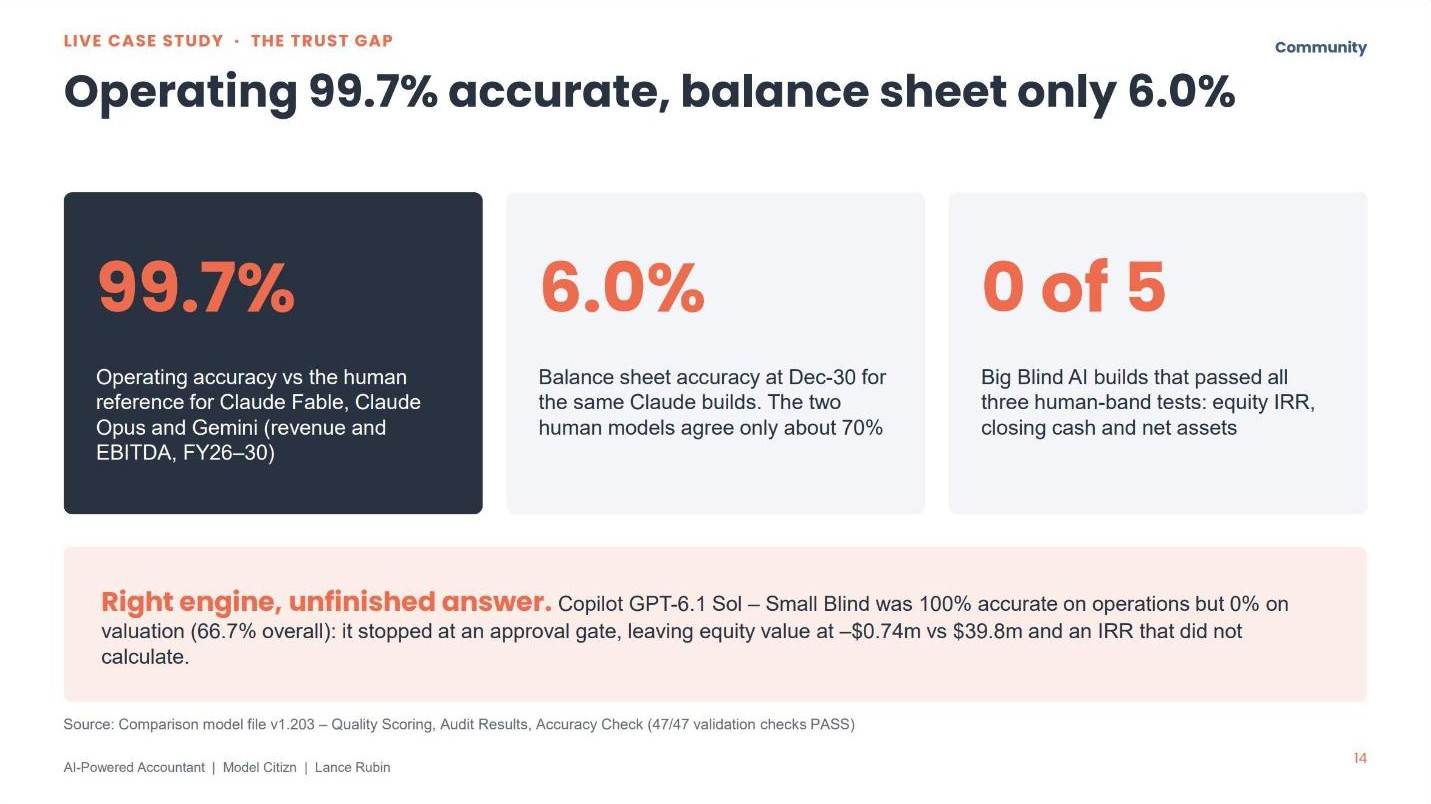
Because the AI makes funding and assumption calls that the brief leaves open, and those calls flow straight into the balance sheet, cash and IRR. Operating accuracy was 99.7% for the Claude and Gemini Big Blind builds. Balance sheet accuracy at December 2030 for the same Claude builds was 6.0%.
Slide 14: the trust gap. Same revenue, very different balance sheets.
Claude Fable 5.2 self-approved 33 default assumptions to keep building, then sized its own equity raises at $18m to keep cash positive. Net assets ended at $6.63m and the equity IRR at 14%. Gemini raised $7.5m, finished with cash of ($9.34m) and an IRR of 24.8%. Same revenue to the cent, two very different businesses.
Humans differ here too. The two human models agree 100% on revenue, EBITDA and ARR, but only about 70% on the balance sheet. The difference is that a human modeller makes those calls deliberately and can defend each one.
This is why balancing is not proof. A model can balance in every month, show no Excel errors and still give the wrong IRR.
98% correct is still 100% wrong.
Lance Rubin, Future of Finance Lab session 14
How do you check an AI-built financial model?
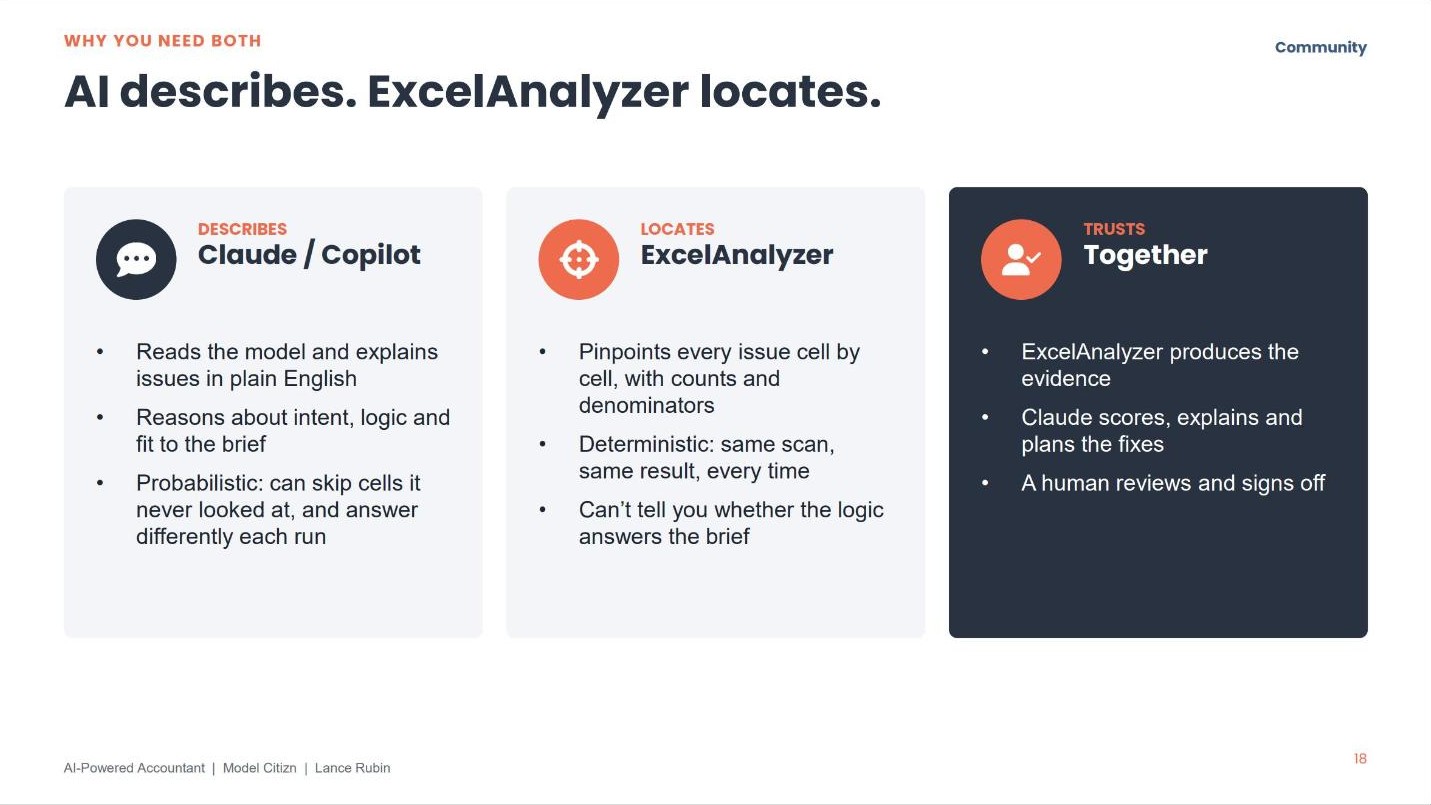
Pair a deterministic checking tool with AI reasoning and a human sign-off, and check both live while the AI builds and again after the build. ExcelAnalyzer locates issues cell by cell with the same result on every scan. Claude or Copilot explains them and plans the fixes. A human decides.
Slide 18: why you need both a deterministic tool and AI.
Disclosure: Model Citizn is an ExcelAnalyzer customer and uses the tool extensively.
Live: check while the AI builds
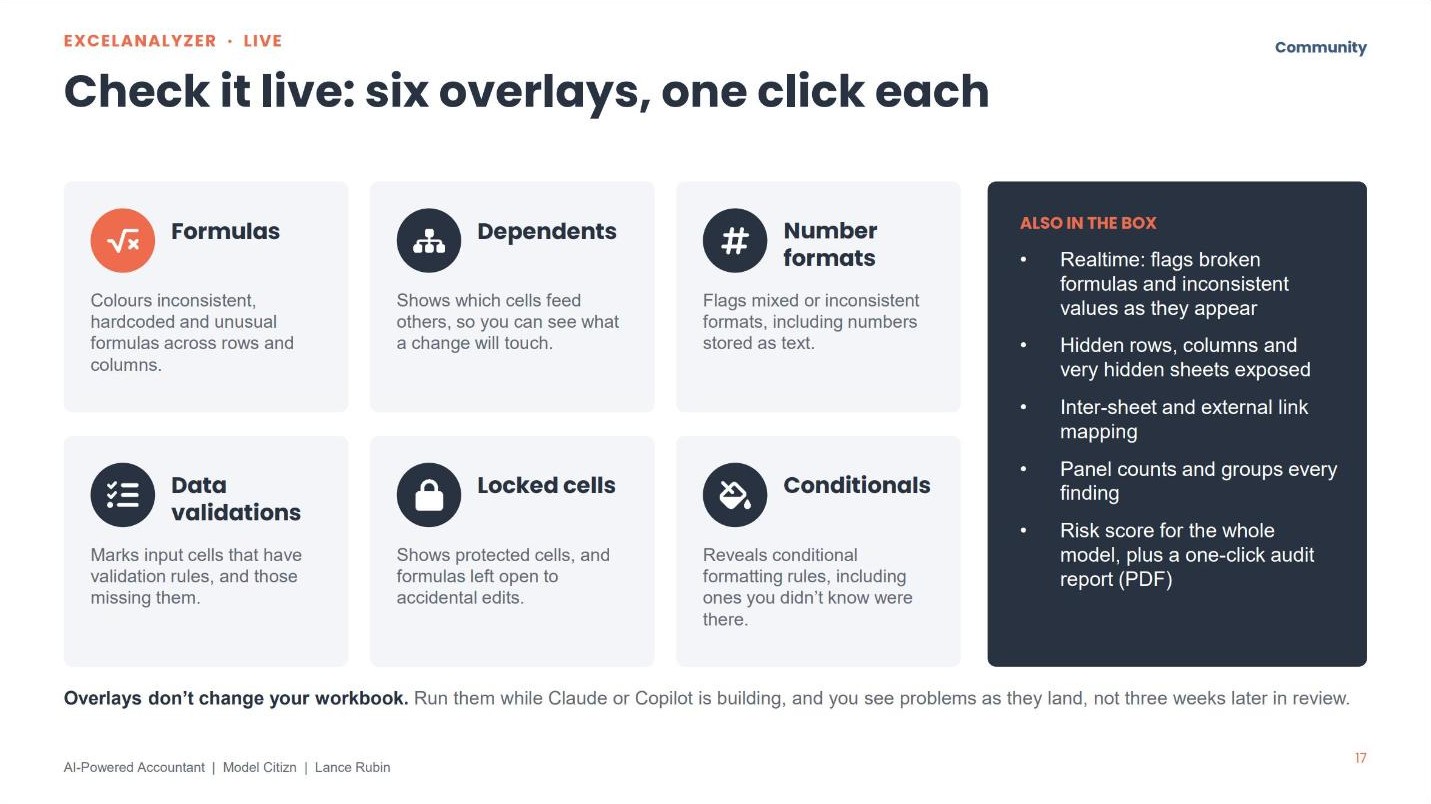
ExcelAnalyzer’s overlays float above the cells and never change the workbook. Maarten compares it to spellcheck in Word. Every unique formula gets its own colour, so a formula copied across a row keeps its colour and a stray +5 changes it straight away.
In the session I ran Claude building a SaaS model with the overlay on. Hardcodes, cross-sheet links and an attempted circular reference showed up as they landed, not three weeks later in review.
Slide 17: ExcelAnalyzer’s live overlays. Click to enlarge.
The six overlays are Formulas, Dependents, Number formats, Data validations, Locked cells and Conditionals. It also exposes hidden rows, columns and very hidden sheets, maps external links and gives the whole model a risk score.
Post-build: benchmark against 175 criteria
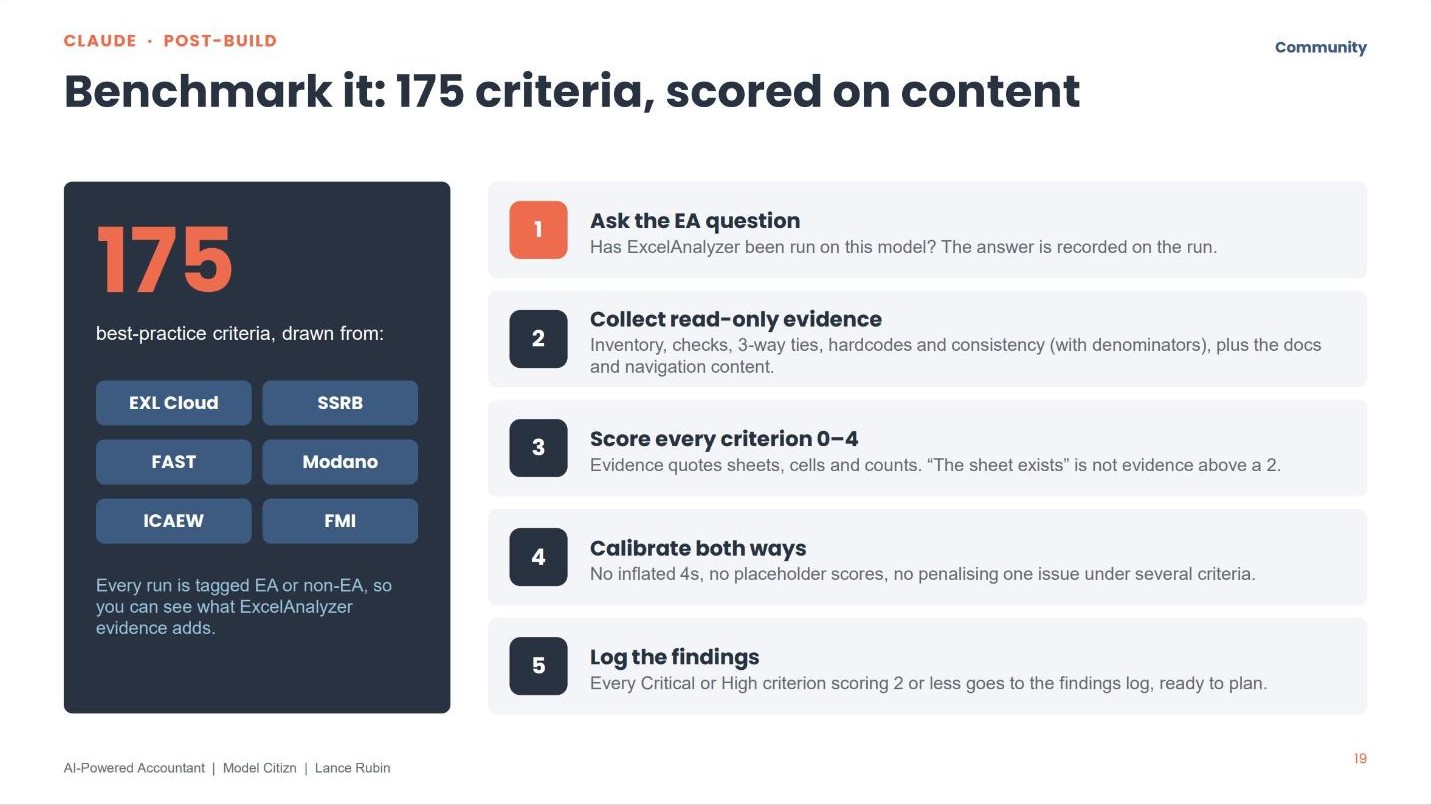
After the build, our benchmarking skill scores the workbook against 175 criteria drawn from six modelling standards: EXL Cloud, SSRB, FAST, Modano, the ICAEW Financial Modelling Code and the FMI. Every criterion is scored 0 to 4 on evidence that quotes sheets, cells and counts, and every Critical or High criterion scoring 2 or less goes to a findings log for remediation.
Slide 19: the post-build benchmark in five steps. Click to enlarge.
The skill works with or without ExcelAnalyzer evidence, and each run is tagged so you can see what the evidence adds. It will be released free as skill 21 in the EXL Cloud skills library.
How can you tell if a financial model was built with AI?
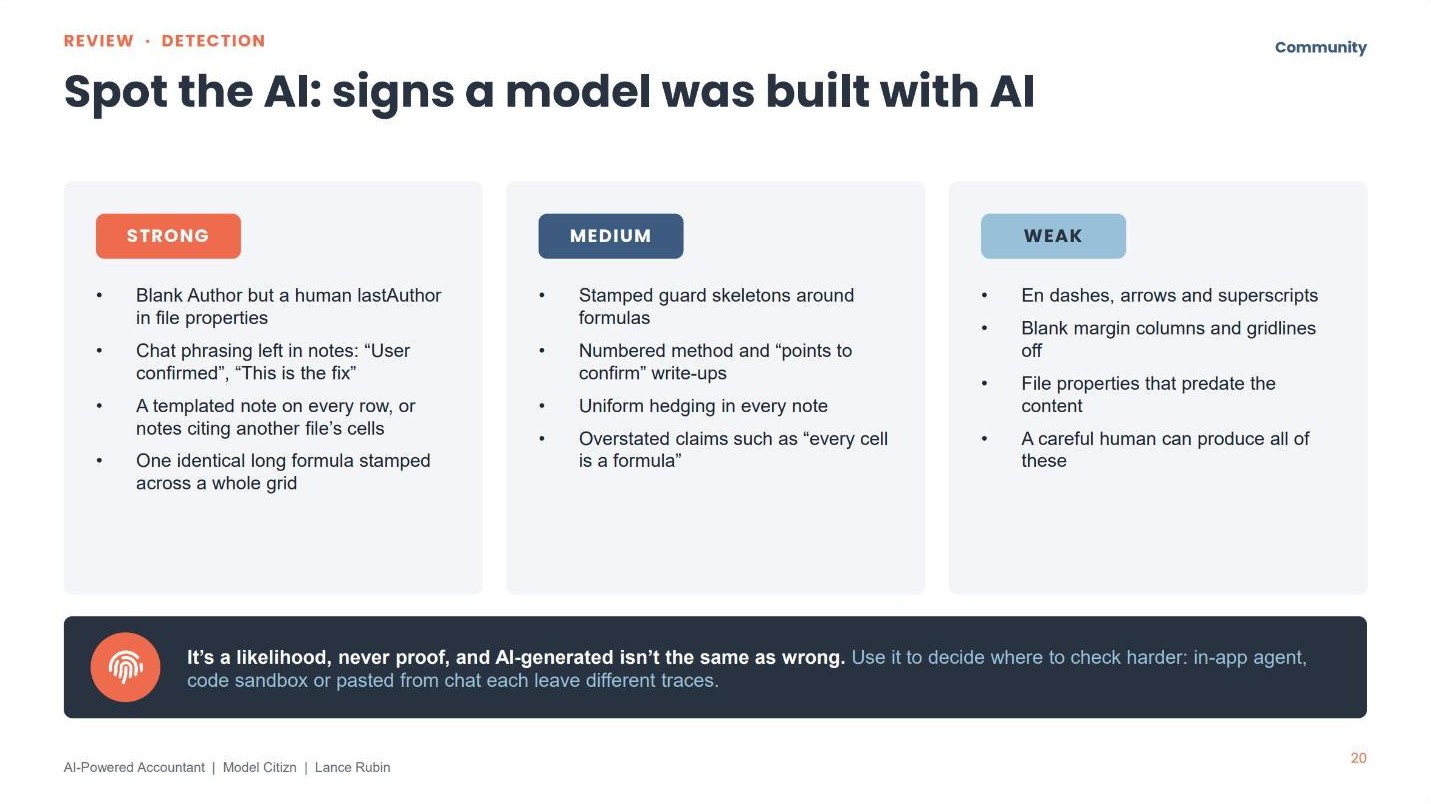
You can’t prove it, but you can spot the likelihood. Use the signs to decide where to check harder, because AI-generated is not the same as wrong.
Slide 20: signs a model was built with AI. Click to enlarge.
The first check costs nothing: open File, then Info, and look at the Author field. Maarten adds a pattern from the review side. Legacy human models are full of inconsistent formulas and hardcodes. AI-built models are more consistent, but leave inputs no formula uses and long formulas that need splitting into steps a reviewer can explain.
What checks should you run before trusting an AI-built model?
Five, and none of them is “it balances”.
Balancing isn’t proof. A 100% tie can just mean the model copied the answer.
Hunt for hidden hardcodes. AI plugs numbers to force a result, so check the trail.
Confidence is not correctness. AI sounds certain even when the logic is wrong.
Audit before you ship. Demand a formula trail for every number before the model leaves your desk, whoever built it.
Keep a human on the logic. Own the structure and the judgement calls yourself.
The operating rule
Own the start, supervise the middle, delegate the end.
Start
Own it
Set the structure and the logic yourself.
Middle
Supervise
Let AI draft formulas, but audit every cell.
End
Delegate
Hand off reporting, commentary and board packs, where AI does its best work.
Ian Schnoor of the Financial Modeling Institute made the point in the session. When someone asks what the IRR is, there is no excuse for a wrong answer, and “the AI built it” is not an explanation.
Is AI ready to replace financial modellers?
No. In our November test the best AI build scored 63/80 against human scores of 66 and 68, and none of the eight AI builds passed all three accuracy tests. AI is a useful assistant for specific modelling tasks, but it cannot yet produce a model that meets professional standards on its own. The best build ran with EXL Cloud modelling skills, which shows how much structure and standards matter.
AI will not replace the finance professional. But finance professionals who embrace AI will replace those who don’t.
How do you evaluate AI financial modelling accuracy?
Every AI build gets the same brief, the same eight-factor rubric and the same audit, and its outputs are checked against the human models. Case Study 5 used ABC Pty Ltd, a 60-month SaaS 3-way model with a cap table and a convertible note. Claude ran skilled in the Claude app, GPT-6.1 Sol ran cold in Copilot in Excel, and Gemini and Grok ran cold in their web apps.
Brief. Every build starts from the same .xlsx file.
Audit. Each workbook is opened in desktop Excel and tested for balance, cash tie, formula errors and hardcodes. Killer flaws cap the affected factors.
Score. Eight factors out of 10 each, for 80 in total.
Accuracy. Revenue, EBITDA, equity IRR, closing cash and net assets are compared with the two human models.
Since the September run, the spread of AI-built IRRs has narrowed from 13% to 158% down to 14% to 25%. Every case study is logged in the tracker below. Click a run to see the cell-by-cell scores and audit commentary.
MODEL CITIZN · AI MODEL EVALUATION FRAMEWORK
AI Model Eval Tracker
Benchmarking AI models on financial modelling — cold vs. skilled, Desktop vs. Excel harness, against Human reference
RUN_007 · Claude, GPT, Gemini & Grok · Big + Small Blind · 10 cells
COMPLETE
Run Date
2026-11-12
Trigger
Case Study 5 — latest-release cross-vendor run (Big Blind + Small Blind, .xlsx only)
Status
COMPLETE
Performance Factors
time Of Day: varioustemperature: defaulttoken Limit: defaultprompt Length: extendednetwork Condition: stableretry Count: 1 (Gemini rerun)system Prompt: defaultthinking Mode: mixed
Notes
Case Study 5 (ABC Pty Ltd SaaS 3-way, 60 months, cap table + convertible note) run on the latest releases from four vendors. Claude Fable 5.2 and Claude Opus 5.5 ran skilled in the Claude app (EXL Cloud skills for Big Blind, saas-model-rebuild-v2 plugin for Small Blind); GPT-6.1 Sol ran cold in Copilot in Excel; Gemini (Thinking) and Grok 4.5 Fast ran cold in the browser. Every starting file is .xlsx. Big Blind = brief only; Small Blind = rebuild a stripped model from its Formula Map.
Scored in Excel on 13 Nov against the 8-factor rubric with audit caps, plus a new output-accuracy check against Human (Craig). Top AI score: Claude Fable 5.2 Big Blind 63/80, the highest AI score in the tracker and three points below the lowest human.
On Big Blind, Fable 5.2, Opus 5.5 and Gemini built identical revenue and EBITDA to the cent (99.7% operating accuracy vs the humans), yet none lands in the human band (blended equity IRR 20.2%–21.6%, Dec-30 closing cash ($2.24M) to ($1.78M), net assets $3.48M–$3.71M): funding differs in every build, so the balance-sheet gap is an assumption call the brief leaves open.
On Small Blind, GPT-6.1 Sol is the only rebuild that calculates in the Excel scoring host and it matches the humans on revenue, EBITDA, cash and net assets (IRR #NUM! on five blank year selectors). The two Claude rebuilds matched the humans on cash and net assets in their own cloud engine but return thousands of #VALUE!/#NAME? errors when opened in Excel, so both are capped at 34/80. No AI build passes all three band tests. Grok's churn formula is inverted (FY30 revenue −86%) and its BS is out $3.27M.
The Gemini and Grok Small Blind cells were not run.
Scoring Matrix · 8 factors × 10 points = 80 max
CELL
HARNESS
VER
CONFIDENCE
COMPLEXITY
STRUCTURE
FLEXIBILITY
VALIDATIONS
DASHBOARDS
AUTOMATION
FIT
TOTAL
%
Claude Fable
SKILLED
Claude App · Big Blind
5.2
8
8
8
8
9
8
6
8
63
/80
79%
Claude Fable
SKILLED
Claude App · Small Blind
5.2
2
6
7
6
4
2
4
3
34
/80
42%
Claude Opus
SKILLED
Claude App · Big Blind
5.5
7
8
8
8
8
7
6
8
60
/80
75%
Claude Opus
SKILLED
Claude App · Small Blind
5.5
2
6
7
6
4
2
4
3
34
/80
42%
GPT
COLD
Copilot (In Excel) · Big Blind
6.1 Sol
2
2
6
4
4
1
2
2
23
/80
29%
GPT
COLD
Copilot (In Excel) · Small Blind
6.1 Sol
2
6
7
6
4
2
4
4
35
/80
44%
Gemini
COLD
Browser · Big Blind
Thinking
4
6
6
6
4
6
6
5
43
/80
54%
Grok
COLD
Browser · Big Blind
4.5 Fast
2
4
5
2
2
4
2
2
23
/80
29%
Human Reference (Lance)
REFERENCE
EXL Cloud 3-Way
V7.11
9
8
8
8
9
8
6
10
66
/80
82%
Human Reference (Craig)
REFERENCE
EXL Cloud 3-Way
V4.6-5g
7
10
9
9
6
9
9
9
68
/80
85%
KILLER FLAWS DETECTED
Grok 4.5 Fast · COLD (Big Blind): Capped: Confidence (forecast hardcodes, BS balance), Validations (BS balance). BS out by $3,267,509 at Dec-30 ($1.0M opening debt and $1.0M CN proceeds never received in cash, $1.07M CN left on the BS after repayment, $199K interest deducted twice); 904 forecast hardcodes; churn formula inverted, FY30 revenue −86%
Claude Fable 5.2 · SKILLED (Small Blind): Capped: Confidence (BS balance n/c), Validations (formula errors, BS balance, cash reconciliation) — subjective 35 → recorded 34. 7,314 error cells (#VALUE!/#NAME?) across the LAMBDA engine when opened in the Excel scoring host, so the BS and cash checks cannot calculate; its own cloud engine had matched the humans
Claude Opus 5.5 · SKILLED (Small Blind): Capped: Confidence (BS balance n/c), Validations (formula errors, BS balance, cash reconciliation) — subjective 35 → recorded 34. 6,775 error cells in the Excel scoring host, on top of the IRR #NUM! / MIRR #DIV/0! from refusing to fill the five blank year selectors (Calcs C294:C298)
GPT-6.1 Sol · COLD (Big Blind): Capped: Confidence and Validations (BS balance, cash reconciliation — statements not built) — subjective 25 → recorded 23. NON-BUILD beyond Time + revenue engine: paused at its own Phase 0 approval gate
GPT-6.1 Sol · COLD (Small Blind): Capped: Confidence (IRR not calculated, #NUM!), Validations (formula errors, cash reconciliation) — subjective 39 → recorded 35. 5 error cells (IRR/XIRR #NUM!) after holding for authorisation on the blank year selectors; CFS↔BS cash gap ($3.55M) inherited from source design; Checks sheet not repaired
Gemini Thinking · COLD (Big Blind): Capped: Confidence (forecast hardcodes). 73 typed calc-sheet constants, 60 of them a zero-depreciation row
LIVE AUDIT COMMENTARY
Claude Fable 5.2 · Big Blind63/80 (79%) · Band 0/3 · Audit 6/6
SKILLED
Unattended subagent with EXL Cloud skills; self-approved 33 Phase 0 defaults. 17 sheets, 21,910 formulas, 2 What-If Data Tables, 7 charts. Passes every deterministic audit check — BS balances and cash ties in all 60 months, zero formula errors, no forecast hardcodes. Revenue and EBITDA are 99.7% accurate against the humans (FY30 revenue $4,587,056 vs $4,576,230). Fails all three band tests on a funding call, not a formula: it sized its own raises to $18M (Seed $2M, Series A $7M Oct-27, Series B $9M Jan-29) to keep Base cash positive, so closing cash is +$1.20M, net assets $6.63M and blended equity IRR 13.96% against a band of 20.2%–21.6%. Highest AI score in tracker history — three points below Lance's 66.
Claude Fable 5.2 · Small Blind34/80 (42%) · Band n/a · Audit 3/6
SKILLED
Formula Map rebuild with the saas-model-rebuild-v2 plugin: 896 of 938 map formulas exact, 42 documented substitutions, 116 LAMBDAs retained. Filled the five blank year selectors (Calcs C294:C298 = 1–5) from evidence inside the file and flagged them for sign-off. In its own cloud engine it matched Craig's reference on equity IRR (21.11% vs 21.10%), closing cash and net assets. Opened in the Excel scoring host, the LAMBDA engine returns 7,314 error cells, so outputs can't be read and the BS and cash checks can't run — capped on Confidence and Validations. Its run report had flagged 'not yet opened in desktop Excel'.
Claude Opus 5.5 · Big Blind60/80 (75%) · Band 0/3 · Audit 6/6
SKILLED
Main session with EXL Cloud skills; four Phase 0 decisions approved by Lance (monthly churn, brief-literal CN conversion, R1 Oct-27 $7M @ $1.25, R2 Apr-29 $9M @ $1.50). 17 sheets, 23,305 formulas; passes every deterministic audit check, with BS and cash tied to 0.00 across 60 months × 3 scenarios and 61/61 reconciliation checks. Revenue and EBITDA identical to Fable 5.2 to the cent. The same $18M funding call puts it outside the band: blended equity IRR 15.01% (1.46x), closing cash +$1.20M, net assets $6.63M. One point behind Fable on each of Confidence, Validations and Dashboards.
Claude Opus 5.5 · Small Blind34/80 (42%) · Band n/a · Audit 3/6
SKILLED
Formula Map rebuild with the plugin: 936 of 938 map formulas exact. Refused to reconstruct the blank year selectors because they are not in the map or a backup, so equity IRR/XIRR return #NUM! and MIRR #DIV/0! even in its own engine; it gave the 1–5 what-if in its report only. Opened in the Excel scoring host, the LAMBDA engine returns 6,775 error cells, so it lands on the same capped 34/80 as Fable. Own verdict: DO NOT SHIP — the most conservative response in the run.
GPT-6.1 Sol · Big Blind23/80 (29%) · Not built · Audit 4/6
COLD
Cold in Copilot in Excel (model selector GPT-6.1 Sol, not Auto). Ran Phase 0 as the prompt requires and stopped at its approval gate: Time and the revenue engine are built (8,013 formulas) and revenue is 98.5% accurate against the humans, but statements, funding and valuation are empty shells. It also flags a 'missing direct-service cost' as blocking everything downstream — the brief has none. Scored as submitted, and capped on Confidence and Validations because there are no statements to check.
GPT-6.1 Sol · Small Blind35/80 (44%) · Band 2/3 · Audit 4/6
COLD
Cold rebuild. Restored all 938 Formula Map formulas and logged a before-snapshot for every spill fix — strong change control. The only Small Blind rebuild that calculates in the Excel scoring host: revenue, EBITDA, ARR, closing cash ($2,138,988) and net assets ($3,611,012) match the humans exactly (100% output accuracy). Held for authorisation on the five blank year selectors rather than guess, so IRR/XIRR read #NUM!. Did not repair the Checks sheet (OVERALL 'NOT VERIFIED'); capped on Confidence because equity IRR can’t be calculated, and on Validations for the error cells and the inherited CFS↔BS cash gap.
Gemini (Thinking) · Big Blind43/80 (54%) · Band 0/3 · Audit 5/6
COLD
Cold in the Gemini web app, Thinking mode. Replaces a first Gemini Flash 3.6 attempt that returned 9 titled sheets with zero formulas. This rerun is a full build: 10 sheets, 10,934 formulas, 4 charts, BS balances and cash ties every month, and revenue and EBITDA identical to both Claude Big Blind builds to the cent. It raised too little — $7.5M of equity (Seed $2M, Series A $2.5M Jan-28, Series B $3.0M Jan-29) — so closing cash is ($9.34M), net assets ($3.88M) and equity IRR 24.76%. Confidence capped for 73 typed calc-sheet constants. Best cold score in the run, in Gemini's first tracker appearance.
Grok 4.5 Fast · Big Blind23/80 (29%) · Band 0/2 · Audit 4/6
COLD
Cold in the Grok web app. A linked monthly 3-way (13 sheets, 4,183 formulas) with structural errors: the churn formula keeps churned customers instead of retained ones (and reads the brief's monthly churn as annual), so FY30 revenue is $0.62M vs $4.58M (−86%). BS out by $3.27M at Dec-30 while its own check reads REVIEW, not FAIL. 904 forecast hardcodes, CN selector not wired, and no IRR, LTV/CAC or discounted valuation. Closing cash ($26.9M). First Grok cell in the tracker; ties GPT Big Blind for the lowest score in the run.
Human Reference (Lance)66/80 (82%)
REFERENCE
Carried from the September benchmark (V7.11). 19,836 formulas, BS balances to <1e-8 and CFS ties; audit 6/6. Sets one edge of the accuracy band: blended equity IRR 20.70%, closing cash ($1,881,820), net assets $3,583,333. Agrees with Craig 100% on revenue, EBITDA and ARR.
Human Reference (Craig)68/80 (85%)
REFERENCE
Carried from the September benchmark (V4.6-5g) and now the reference for the output-accuracy check. Dynamic-array build with 1,925 anchor formulas, 885 named ranges and 24 sheets. Sets the other edge of the band: equity IRR 21.10%, closing cash ($2,138,988), net assets $3,611,012. Audit 5/6 — the same CFS↔BS cash gap the Small Blind rebuilds inherit.
PER-FACTOR OBSERVATIONS — WHERE TO DIVE DEEPER
CONFIDENCE
Fable 5.2 Big Blind 8 and Opus 5.5 Big Blind 7, although neither lands in the human band. The new assumption gate shows funding differs in every build, so the Dec-30 balance-sheet gaps are assumption-driven, while operating accuracy is 99.7% against the humans. Gemini 4; GPT Small Blind (capped: IRR not calculated), both Claude Small Blinds, GPT Big Blind and Grok 2. Dive: whether the human-band rule should test operating outputs only when funding assumptions differ.
COMPLEXITY
Claude Big Blind builds 8 (21.9k and 23.3k formulas with CN, cap table, debt, DCF and scenario grids). Small Blind rebuilds 6 on the inherited 116-LAMBDA engine; Gemini 6 with 10.9k formulas; Grok 4; GPT Big Blind 2 (revenue engine only). Dive: Gemini matches Claude's revenue engine with half the formulas.
STRUCTURE
The most even factor, 5–8 across every build. Fable and Opus converged on the same 17-sheet Inputs → Time → Calcs → schedules → Statements → Valuation → Checks layout (8 each). Grok 5 — drivers on calc sheets, no change log. Dive: two Claude models, one layout — is that the skills or the models?
FLEXIBILITY
Claude Big Blind 8: Base/Upside/Downside switching, with a CN round selector and warnings (Opus) or a CN-outcomes data table (Fable). Small Blinds and Gemini 6; GPT Big Blind 4; Grok 2 — its CN selector isn't wired, so the note redeems for cash whatever the setting.
VALIDATIONS
Fable 5.2 Big Blind 9 — the top AI score on this factor, level with Lance. Opus Big Blind 8 with 61/61 reconciliation checks. Every other AI build is 4 or lower after caps: error cells and uncalculated checks on the Small Blinds, no statements on GPT Big Blind, and Grok's self-check reading REVIEW while its BS is out $3.27M (2).
DASHBOARDS
Fable Big Blind 8 (Executive Dashboard, 7 charts), Opus 7, Gemini 6 (KPIs, cap table, 4 charts), Grok 4 (typed cap table). Small Blinds 2 — the starting file has no dashboards and none was added. GPT Big Blind 1.
AUTOMATION
Ceiling of 6 this run: Fable, Opus and Gemini Big Blind all score 6, level with Lance. Small Blinds 4; GPT Big Blind and Grok 2 (Grok types rates and payments inside formulas). Craig's 5g build (9) remains the automation benchmark.
FIT
Claude Big Blind 8 — every brief component (CN conversion, cap table, term debt, DCF, LTV/CAC, equity and note IRRs). Gemini 5; GPT Small Blind 4; Claude Small Blinds 3; GPT Big Blind and Grok 2. The five blank year cells split the Small Blinds: fill and flag (Fable), ask and hold (GPT), refuse (Opus).
FMI Global Conference — 13-cell cross-platform comparison
Status
COMPLETE
Performance Factors
time Of Day: varioustemperature: defaulttoken Limit: defaultprompt Length: extendednetwork Condition: stableretry Count: 0system Prompt: defaultthinking Mode: extended
Notes
Comprehensive 13-cell comparison for the FMI Global Conference presentation. Tests Perplexity, 5G AI (Claude Opus 4.8), Claude Fable 5 & 5.1, GPT 5.6 (Copilot), and two human references (Lance & Craig) across Big Blind, Small Blind, and Small Blind + cheat configurations. Case study: SaaS 3-Way DCF with cap table and convertible note. Cells 12–13 add Fable 5.1 builds on a revised starting file (8.9.26 v2).
Key finding: Cell 13 (Fable 5.1 Big Blind) achieves 61/80 with ZERO killer flaws and a perfect 10/10 audit — the only AI build in tracker history to pass every deterministic check. Cell 12 (Fable 5.1 Small Blind) scores 50/80 (recorded) with a CFS↔BS cash gap inherited from the source design. Human Craig remains the top scorer at 68/80.
Scoring Matrix · 8 factors × 10 points = 80 max
CELL
HARNESS
VER
CONFIDENCE
COMPLEXITY
STRUCTURE
FLEXIBILITY
VALIDATIONS
DASHBOARDS
AUTOMATION
FIT
TOTAL
%
Perplexity (Claude Opus)
COLD
Perplexity
4.5
1
3
4
1
1
5
1
2
18
/80
22%
Claude Opus
SKILLED
5G AI (In Excel)
4.8
4
9
9
8
4
7
9
7
57
/80
71%
Claude Opus
COLD
5G AI (In Excel)
4.8
1
9
8
3
2
7
3
4
37
/80
46%
Claude Opus
SKILLED
5G AI (In Excel)
4.8
4
9
9
8
4
6
9
7
56
/80
70%
Human Reference (Lance)
REFERENCE
EXL Cloud 3-Way
V7.11
9
8
8
8
9
8
6
10
66
/80
82%
Human Reference (Craig)
REFERENCE
EXL Cloud 3-Way
V4.6-5g
7
10
9
9
6
9
9
9
68
/80
85%
Claude Fable
COLD
Claude App
5.0
2
8
9
8
8
8
8
7
58
/80
72%
Claude Fable
COLD
In Excel
5.0
2
7
7
7
8
7
7
5
50
/80
62%
Claude Opus
SKILLED
5G AI (In Excel)
4.8
2
8
9
3
2
6
3
4
37
/80
46%
GPT
SKILLED
Copilot (In Excel)
5.6
4
9
9
8
4
6
9
5
54
/80
68%
GPT
COLD
Copilot (In Excel)
5.6
1
1
2
1
1
1
1
1
9
/80
11%
Claude Fable
SKILLED
Claude.ai (In Excel)
5.1
4
10
8
8
4
2
8
6
50
/80
subj: 61
62%
Claude Fable
COLD
Claude.ai (In Excel)
5.1
2
9
9
8
10
7
7
9
61
/80
76%
KILLER FLAWS DETECTED
Perplexity (Claude Opus) · COLD: Zero formulas — entire model is static/hardcoded (4,713 literal values); BS unbalanced by ~$5.1M every period; No dynamic array or formula engine
Claude Opus · SKILLED: CFS does not reconcile to BS cash (~$3.48M cumulative gap); Zero-formula-count cosmetic #REF! on nav links
Claude Opus · COLD: 41 #SPILL! errors across Calcs sheets (time-series collisions); BS balance off by ~$9.70 (rounding, not structural); Flexibility capped — scenario selector present but drivers broken by spill errors
Claude Opus · SKILLED: CFS does not reconcile to BS cash (~$3.55M cumulative gap); Unfunctional scenario/sensitivity checks
Claude Opus · SKILLED: Formulas stripped to values on rebuild — only 574 of 944 intended formulas survive; CFS does not reconcile to BS cash (~$3.55M gap); #NUM! errors on IRR/XIRR calculations
GPT · SKILLED: CFS does not reconcile to BS cash (~$1.08M max period gap); Zero genuine forecast hardcodes but dynamic-array spill architecture
GPT · COLD: NON-BUILD: unmodified starting file returned as output; All 8 factors capped — dead shell with 171 formulas (all inherited); 12 broken cross-sheet links; 6 of 9 tabs empty or unmodified
Claude Fable · SKILLED: CFS does not articulate to BS — cumulative gap $3,547,710; COGS positive in CFS; faithful to source design (identical defect exists in human reference starting file) but breaks 3-way articulation; caps Confidence and Validations at 4/10
LIVE AUDIT COMMENTARY
Perplexity (Claude Opus)18/80 (22%)
COLD
Non-functional static output. Perplexity generated 11 sheets of reasonable-looking structure but every cell is a hardcoded literal — 4,713 values, zero formulas. BS never balances (~$5.1M gap). The Dashboard tab earns the only non-floor score (5/10) because charts and layout exist, even though the underlying numbers are static. This is the baseline for what happens when the harness has no Excel write capability.
Claude Opus57/80 (71%)
SKILLED
Small Blind with EXL Cloud skills loaded and cheat sheet. 2,388 anchor formulas plus ~26,567 dynamic-array spill children. Strong complexity (9/10) — full 5-tier revenue, convertible note, cap table, exit valuation. BS balances to 1e-8 but CFS breaks by ~$3.48M cumulative, capping Confidence and Validations at 4. Automation (9/10) reflects the dynamic-array architecture. The 5G harness produces the most sophisticated AI structure in this cohort.
Claude Opus37/80 (46%)
COLD
Big Blind fail — same 5G architecture as the SB cheat cells but without skills, resulting in 41 #SPILL! errors where time-series formulas collide. Complexity still scores 9/10 (the structure and component coverage is there) but Confidence drops to 1/10 and Automation to 3/10 because the spill errors break downstream calculations. Shows that the 5G dynamic-array approach is fragile without guided setup.
Claude Opus56/80 (70%)
SKILLED
Small Blind with extensive back-and-forth prompting plus cheat sheet. Nearly identical to Cell 2 (SB cheat) — same 5G architecture, same CFS break (~$3.55M vs $3.48M). Dashboards score slightly lower (6 vs 7) — Chart Data present but no dedicated Exec Summary. Demonstrates that additional prompting iterations don't materially improve the 5G build when the underlying CFS reconciliation issue persists.
Human Reference (Lance)66/80 (82%)
REFERENCE
Lance's human reference build. 19,836 formulas, BS balances to <1e-8, CFS ties exactly. Full 3-Way with scenario manager. Automation lower (6/10) vs prior V7.11 benchmark (8/10) — reflects the specific brief's scope rather than a template ceiling. Fit-to-Brief is 10/10: every component of the case study brief is addressed. This is the practitioner benchmark for the FMI conference comparison.
Human Reference (Craig)68/80 (85%)
REFERENCE
Craig's human reference build using the 5G/EXL Cloud methodology. 1,925 formulas with 883 named ranges and 24 sheets — the most complex tab structure in the cohort. Complexity 10/10 — the only cell to achieve a perfect complexity score, reflecting the full 5G architecture including dynamic arrays. Confidence at 7 (not 9) because CFS has a ~$3.48M gap (same structural issue as the AI 5G builds). Highest total score in the run at 68/80.
Claude Fable58/80 (72%)
COLD
Fable 5 second release via Claude App (Big Blind — no skills loaded). 11,916 formulas, BS balances to 2.7e-9, CFS ties exactly. Zero killer flaws. Confidence low (2/10) despite clean audit because output magnitudes differ significantly from brief expectations — the model runs but numbers need calibration. This is Fable's best showing: jumping from 54 (Run 4 Desktop) and 62 (Run 5 Excel) to 58 on a harder brief, cold.
Claude Fable50/80 (62%)
COLD
Fable 5 first release via Excel harness (Big Blind). 11,478 formulas, BS balances exactly across all 60 periods, CFS ties to BS cash. Zero killer flaws. Lower than the Claude App build (50 vs 58) — the Excel harness constrains Fable's output structure compared to the free-form Claude App approach. Fit-to-Brief capped at 5/10 due to missing convertible-note logic and limited exit valuation.
Claude Opus37/80 (46%)
SKILLED
Small Blind with EXL Cloud skills but NO cheat sheet. The 5G architecture is present (883 named ranges, 21 sheets) but the rebuild process stripped formulas to values — only 574 of 944 intended formulas survive, dropping Automation to 3/10. Same CFS break as other 5G builds. This is the control case: skills alone without the cheat sheet produce a structurally complete but computationally broken model.
GPT54/80 (68%)
SKILLED
GPT 5.6 via Microsoft Copilot, Small Blind. 1,914 formulas with 883 named ranges — adopts the same 5G/DA methodology as the Claude 5G builds. Complexity and Structure both 9/10, matching the best AI cells. The CFS break (~$1.08M) caps Confidence and Validations at 4. GPT 5.6 in Copilot is a major step up from GPT 5.5 (which scored 33 and 23 in prior runs) — the 5G methodology elevates it.
GPT9/80 (11%)
COLD
Big Blind GPT 5.6 via Copilot — NON-BUILD. The output is the unmodified starting file: 171 formulas (all inherited from the template), 6 of 9 tabs empty, 12 broken cross-sheet links. Every factor floors at 1/10 except Structure (2/10, for having the starting file's tab layout). This is the worst result in the entire tracker history. GPT 5.6 in Copilot cannot build a model from scratch without skills.
Claude Fable50/80 (62%) · subj 61/80
SKILLED
Fable 5.1 Small Blind on revised starting file (8.9.26 v2). 23-sheet dynamic-array build with ~120 custom LAMBDAs — the most formula-complex AI output in the cohort. Complexity 10/10 (the only AI cell to match Craig's perfect complexity). The CFS↔BS cash gap ($3,547,710) is inherited from the source design — identical to the defect in the human reference starting file — capping Confidence and Validations at 4. Recorded score 50/80; subjective score 61/80 adjusting for the inherited design limitation. Dashboards low (2/10) — Chart Data present but no dedicated summary views.
Claude Fable61/80 (76%)
COLD
Fable 5.1 Big Blind on revised starting file (8.9.26 v2). LANDMARK RESULT: the only AI build in tracker history with ZERO killer flaws AND a perfect 10/10 on all deterministic audit checks. 17-sheet INDEX/MATCH + SUMPRODUCT row-driven architecture — closing cash ties to BS ($0.00 variance), BS balances exactly, net assets tie, Σ net cash movement ties. Validations 10/10 — the first AI cell to achieve a perfect validation score. Confidence at 2/10 because output magnitudes diverge from brief expectations (IRR 46.75% vs ground-truth 20.7–21.1%). Fit-to-Brief 9/10 — full convertible note, cap table, exit valuation. This is the new AI high-water mark at 61/80 (76%).
PER-FACTOR OBSERVATIONS — WHERE TO DIVE DEEPER
CONFIDENCE
Wide spread: humans 7–9, best AI 4 (capped by CFS breaks), worst 1 (non-build or static). The CFS reconciliation issue persists across 6 of 13 cells — both 5G and Fable 5.1 SB builds. Cell 13 (Fable 5.1 BB) breaks the pattern: clean CFS but Confidence still 2/10 due to magnitude divergence. Dive: root-cause the CFS↔BS gap and separate reconciliation confidence from magnitude confidence.
COMPLEXITY
5G methodology lifts both Claude and GPT to 9/10. Craig (human) and Fable 5.1 SB (Cell 12) share the only 10s — Fable 5.1 SB is the first AI cell to match human-level complexity with ~120 custom LAMBDAs. Cell 13 (Fable 5.1 BB) scores 9 with a simpler INDEX/MATCH architecture. Perplexity and BB GPT floor at 1–3. Dive: compare LAMBDA-driven vs INDEX/MATCH approaches for model sophistication.
STRUCTURE
5G tab taxonomy (Inp*/Time/Calcs/Statements) scores 8–9 across all 5G builds. Fable 5.1 BB also hits 9 with a distinct 17-sheet architecture. Fable 5.1 SB scores 8 with 23 sheets. The methodology, not the model, drives structure — but Fable 5.1 demonstrates that both LAMBDA-rich and row-driven approaches can achieve high structure scores. Dive: compare 23-sheet vs 17-sheet layouts for auditability.
FLEXIBILITY
Scenario selectors work in SB builds (8/10) including both Fable 5.1 cells. Cell 13 BB achieves 8/10 Flexibility — unusual for a Big Blind build and a significant advance over prior BB results (typically 1–3). The 5G architecture's spill-dependent drivers remain fragile without guided setup. Dive: how does Fable 5.1 BB maintain scenario flexibility without a starting file?
VALIDATIONS
Cell 13 (Fable 5.1 BB) achieves a PERFECT 10/10 — first AI cell in tracker history. Every deterministic check passes: BS balances, CFS ties, no formula errors, no broken links, full citation resolution. Fable 5.0 leads at 8/10. 5G builds cap at 4 because CFS doesn't reconcile. Dive: what architectural choices let Cell 13 pass all 10 checks where every other AI build fails at least one?
DASHBOARDS
Human Craig tops at 9/10 (Exec + SaaS dashboards). AI range: 1 (non-build) to 8 (Fable App). Cell 12 (Fable 5.1 SB) scores only 2/10 — Chart Data present but no dedicated summary views, the lowest Fable dashboard score. Cell 13 (Fable 5.1 BB) recovers to 7/10. Dive: why does the SB starting file constrain dashboard output vs the BB free-form approach?
AUTOMATION
5G dynamic-array builds score 9/10 (SB variants). Cell 12 (Fable 5.1 SB) scores 8/10 with ~120 custom LAMBDAs — a different automation approach to spill chains. Cell 13 (Fable 5.1 BB) scores 7/10 with INDEX/MATCH. The spectrum: LAMBDA-driven (Cell 12) vs dynamic-array (5G) vs row-driven (Cell 13) automation approaches. Dive: compare formula:input ratios and audit-trail clarity across automation styles.
FIT
Human Lance 10/10, Craig 9/10. Cell 13 (Fable 5.1 BB) matches Craig at 9/10 — the first AI cell to reach this level, with full convertible note, cap table, and exit valuation. Cell 12 (Fable 5.1 SB) scores 6/10. Prior AI range: 1 (non-build) to 7 (5G SB with cheat). Dive: what Fable 5.1 BB delivers that prior AI builds missed on cap-table and convertible-note logic.
2026-06-14
SAAS Model — Fable release (Excel Harness)
RUN_005 · Harness comparison: Excel live audit vs Desktop · 5 cells
COMPLETE
Run Date
2026-06-14
Trigger
Harness comparison: Excel live audit vs Desktop
Status
COMPLETE
Performance Factors
time Of Day: 10:00temperature: defaulttoken Limit: defaultprompt Length: extendednetwork Condition: stableretry Count: 0system Prompt: defaultthinking Mode: extended
Notes
Same ABC Pty Limited SaaS 3-Way brief as RUN_004 but scored via connected-workbook Excel harness (live read-only audit of actual .xlsb files) vs the Desktop harness used in RUN_004. Excel harness enables formula counting, colour-code sampling, structural verification, and BS/CFS tie-out — producing higher-confidence scores. Key finding: all Claude models scored higher under Excel harness scrutiny, with Fable jumping 54→62 (+8) and Opus 53→58 (+5). Copilot Opus was the biggest surprise, rising 40→48 (+8) — the #0000FF input audit confirmed proper colour coding missed by Desktop review. GPT dropped 33→23 as the Excel harness exposed that revenue/opex engines were never wired (all zeros despite clean BS).
Scoring Matrix · 8 factors × 10 points = 80 max
CELL
HARNESS
VER
CONFIDENCE
COMPLEXITY
STRUCTURE
FLEXIBILITY
VALIDATIONS
DASHBOARDS
AUTOMATION
FIT
TOTAL
%
Claude Fable
SKILLED
Claude.ai
5.0
8
8
8
8
8
7
7
8
62
/80
78%
Claude Opus
SKILLED
Claude.ai
4.8
8
8
8
8
7
6
6
7
58
/80
72%
Claude Opus (Copilot)
COLD
Microsoft Copilot
4.8
7
6
6
6
6
6
6
5
48
/80
60%
GPT
COLD
Microsoft Copilot
5.5
3
3
4
3
2
2
3
3
23
/80
29%
Human Reference
REFERENCE
EXL Cloud 3-Way
V7.11
9
9
9
9
10
9
9
10
74
/80
92%
KILLER FLAWS DETECTED
GPT · COLD: Revenue/opex engines never wired — all output zeros; 7 of 13 tabs completely empty; Repeated build failures (attempt 3 filename); No colour coding (135/636 inputs black)
LIVE AUDIT COMMENTARY
Claude Fable62/80 (78%)
SKILLED
Best-built AI model in the cohort. 11,478 formulas at >18x inputs, zero errors, balances and cash-ties across all 60 months / 20 quarters / 5 years. Full colour coding (blue inputs / green links / black formulas) and all 8 brief components present, incl. dual-condition convertible note with scenarios + IRR, PPT data PAL, AR & C equity rounds + 10% ESOP, exit valuation and a SaaS LTV/CAC dashboard. Original Desktop hand score under-rated Validations (6→8) and Automation (5→7); Excel evidence supports uplift. Dive deeper: convertible-note logic and SaaS metric definitions for assumption realism.
Claude Opus58/80 (72%)
SKILLED
Structurally the most complete AI build — the only AI cell with a dedicated Change Log alongside Overview, Master Control, Dashboard and an 11-control Checks sheet. 8,068 formulas at 13.5x inputs, zero errors, BS balances every period. The single FLAG (18 periods of negative closing cash) is an output observation, not a build error — a worthy funding/review hold. Held back from Fable only by partial colour coding (funding inputs blue, many assumptions black). Dive deeper: the negative-cash periods and whether the Downside scenario drives them.
Claude Opus (Copilot)48/80 (60%)
COLD
The biggest positive surprise of the run. Its COD/GST label and 48/80 original score understated it: #0000FF inputs on 20/20 sampled cells, all 6 internal checks pass, BS ties >2e-8, NMF reconciles to ~CFS, and a Dashboard + Sensitivity are present. The genuine gap is scope — no convertible-note logic, funding modelled as priced equity rounds only — which caps Complexity and Fit. Also no Instructions/Change Log and plain tab naming. Dive deeper: decide whether the missing convertible-note instrument is material to the ABC Pty brief.
GPT23/80 (29%)
COLD
Marked DOWN on live audit. On paper it looks clean — 0 formula errors, BS balances, cash ties — but this is a hollow pass: every revenue/opex/funding line resolves to 0 because the engines were never wired in, and 7 of 13 tabs are completely empty. No colour coding (135/636 inputs black) and an attempt-3 filename pointing to repeated build failures. This is the case study for why a balanced balance sheet is necessary but not sufficient. Dive deeper: not worth salvaging cell-by-cell — re-run with skills loaded.
Human Reference74/80 (92%)
REFERENCE
The benchmark, and it holds up: 19,830 formulas, zero errors, BS balances to <2e-8, dedicated Validations + Checks all passing, and full coverage of all 8 components including the Scenario Manager. Live audit confirms the original 74 with only offsetting nuance — a small structure deduction (no dedicated Change Log, plain tab naming) balanced by full automation. This is the standard the AI cells are measured against — use it to calibrate what good looks like per factor.
PER-FACTOR OBSERVATIONS — WHERE TO DIVE DEEPER
CONFIDENCE
Would you send this without re-checking it? Fable & both Opus builds earn 7-8 (clean, tie out). GPT drops to 3 — the output is all zeros. Dive: re-perform a sample of each model's headline outputs against the brief.
COMPLEXITY
Sophistication & completeness of the modelling. Driven by component coverage: Copilot-Opus capped at 6 (missing convertible notes); GPT at 3 (engines empty). Dive: convertible-note and ESOP mechanics.
STRUCTURE
Organisation, separation of inputs/calcs/outputs, navigation. Opus-Claude leads the AI cohort (dedicated Change Log). GPT's 7 empty tabs sink it. Dive: tab taxonomy and input/calc separation.
FLEXIBILITY
Scenario/driver flexibility. Working scenario managers in all Claude builds (Base/Upside/Downside); GPT's none functional. Dive: scenario switch wiring and driver sensitivity.
VALIDATIONS
Coverage & integrity of built-in checks. Fable's 20-check panel is best of cohort; GPT's Checks tab is empty. This factor shows the biggest original-vs-live swing. Dive: which checks each model actually runs vs claims.
DASHBOARDS
Output visualisation & decision-readiness. Fable's SaaS LTV/CAC dashboard is the strongest AI dashboard; GPT's dashboard tab is empty. Dive: are the dashboards linked live to outputs or static.
AUTOMATION
Formula-driven & dynamic vs manual/hardcoded. Measured by formula:input ratio + colour discipline. Human 21.5x, Fable >18x, GPT 2.66x with no colour coding. Dive: forecast-zone hardcode scan beyond the headline count.
FIT
Does it meet the ABC Pty SaaS brief end-to-end? Fable full hit; Copilot Opus dinged for the missing convertible-note instrument; GPT non-functional. Dive: brief line-items vs delivered components.
2026-06-11
SAAS Model — Fable release (Desktop Harness)
RUN_004 · Model release: Claude Fable 5.0 · 5 cells
COMPLETE
Run Date
2026-06-11
Trigger
Model release: Claude Fable 5.0
Status
COMPLETE
Performance Factors
time Of Day: 10:00temperature: defaulttoken Limit: defaultprompt Length: extendednetwork Condition: stableretry Count: 0system Prompt: defaultthinking Mode: extended
Notes
ABC Pty Limited SaaS 3-Way model brief — scored via Desktop harness (Claude.ai / Copilot UI review). Tests 5-tier revenue engine, payroll grades, convertible note dual-condition logic, debt P&I, equity rounds + ESOP, exit valuation, SaaS metrics dashboard. Human Reference is SAAS Financial Model Solution V7.11. File format .xlsb — audit based on metadata and structural signals due to MIME-type read limitation. See RUN_005 for the same brief re-scored under Excel harness with connected workbooks.
time Of Day: 14:00temperature: defaulttoken Limit: defaultprompt Length: standardnetwork Condition: stableretry Count: 0
Notes
First end-to-end evaluation. Christmas Day run. Established baseline scoring across cold and skilled tracks. Human reference fixed as EXL Cloud 3-Way V11.27.
Scoring Matrix · 8 factors × 10 points = 80 max
CELL
HARNESS
VER
CONFIDENCE
COMPLEXITY
STRUCTURE
FLEXIBILITY
VALIDATIONS
DASHBOARDS
AUTOMATION
FIT
TOTAL
%
Claude Opus
COLD
Claude.ai
4.6
5
6
5
4
4
5
4
6
39
/80
49%
Claude Opus
SKILLED
Claude.ai
4.6
7
7
8
7
7
6
6
8
56
/80
70%
GPT
COLD
Microsoft Copilot
5.0
4
5
5
4
4
4
4
5
35
/80
44%
GPT
COLD
Microsoft Copilot
5.0
6
6
6
5
6
5
5
7
46
/80
57%
Human Reference
REFERENCE
EXL Cloud 3-Way
V11.27
9
9
10
9
10
9
8
10
74
/80
92%
KILLER FLAWS DETECTED
Claude Opus · COLD: Hardcoded forecast in revenue line; Missing BS reconciliation
GPT · COLD: Hardcoded forecast values; Formula errors (#REF!) in CFS
GPT · COLD: BS not balanced
Score Trajectory Across Releases
TOTAL SCORE OVER TIME · MAX 80
Claude Opus · Cold
Claude Opus · Skilled
GPT · Cold
Human Reference
Claude Fable · Skilled
Claude Opus (Copilot) · Cold
Perplexity (Claude Opus) · Cold
Claude Fable · Cold
GPT · Skilled
GPT · Cold
Claude Fable 5.1 · Skilled
Claude Fable 5.1 · Cold
Gemini · Cold
Grok · Cold
RUN-OVER-RUN DELTAS
CELL
2025-12-25
2026-06-11
2026-06-14
2026-08-26
2026-11-12
Δ TOTAL
Claude Opus · Cold
39
0
0
37
0
-39
Claude Opus · Skilled
56
53
58
57
60
+4
GPT · Cold
46
33
23
0
23
-23
Human Reference
74
74
74
68
68
-6
Claude Fable · Skilled
0
54
62
0
63
+63
Claude Opus (Copilot) · Cold
0
40
48
0
0
0
Perplexity (Claude Opus) · Cold
0
0
0
18
0
0
Claude Fable · Cold
0
0
0
58
0
0
GPT · Skilled
0
0
0
54
0
0
GPT · Cold
0
0
0
9
0
0
Claude Fable 5.1 · Skilled
0
0
0
50
0
0
Claude Fable 5.1 · Cold
0
0
0
61
0
0
Gemini · Cold
0
0
0
0
43
+43
Grok · Cold
0
0
0
0
23
+23
Evaluation Methodology
Two Tracks per Run
Cold (no skills) vs Skilled (EXL Cloud SKILL.md loaded). Same matrix every run, isolating skill contribution from raw model capability.
Human Reference Fixed
EXL Cloud 3-Way model regardless of brief. Aspirational benchmark — apples-to-oranges by design, documented.
Killer-Flaw Caps
Hardcoded forecast values, formula errors, BS-balance failures auto-cap relevant rubric factors at 4/10. Surfaced as cell-comments.
Watch the replay at the top of this post, or download the full deck. It covers the Case Study 5 results, the ExcelAnalyzer overlays, the 175-criteria benchmark and the signs of an AI-built model.
Maarten Bessems founded Spreadsheetsoftware in Maastricht, the team behind ExcelAnalyzer, ExcelCompare and Gridbox, after ten years as a senior financial modeller at the Netherlands’ largest real estate company. He has built, reviewed or audited more than 1,000 spreadsheet models. His view: review matters more in the AI era, not less.
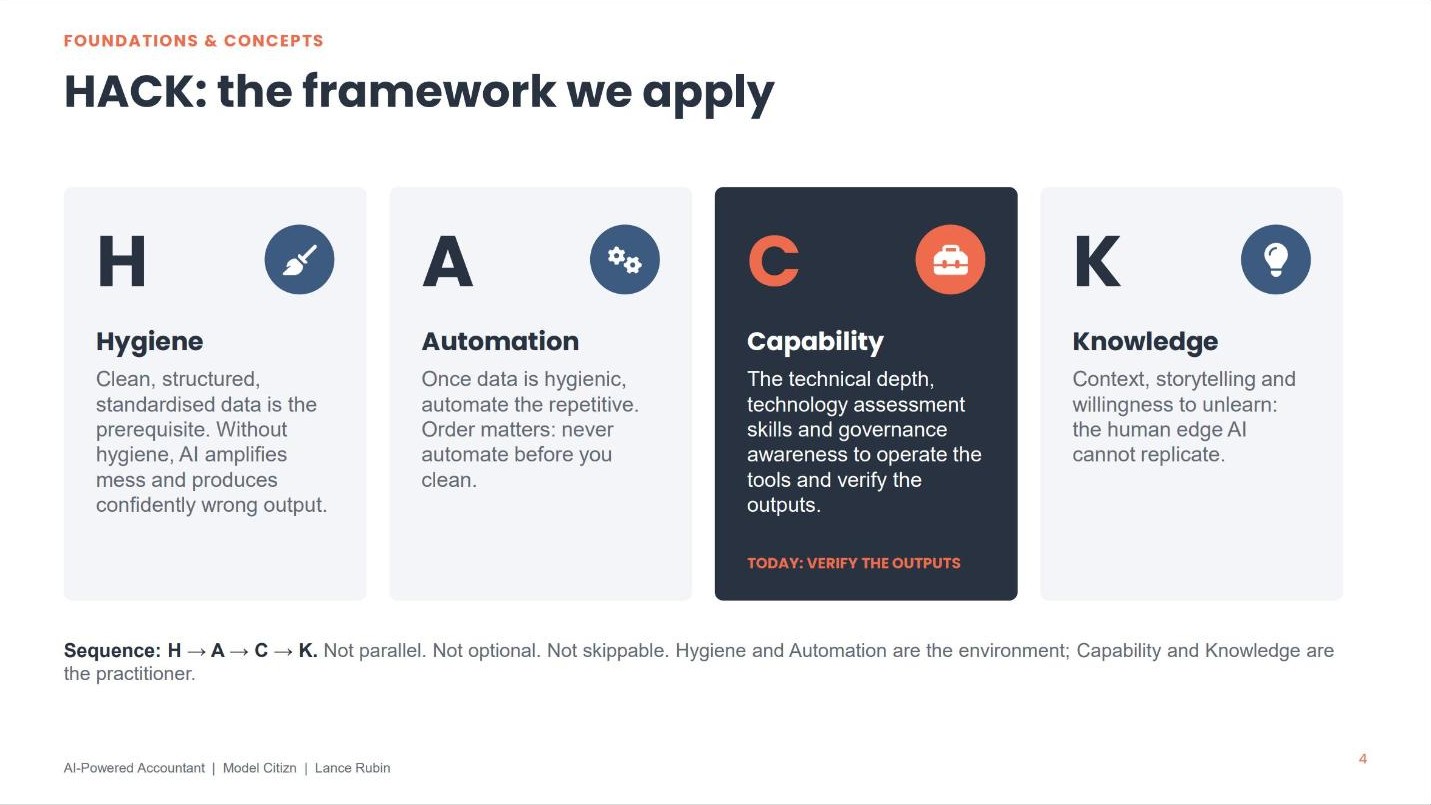
Checking AI-built models is the Capability stage of HACK
We re-run the evaluation when major models ship and add each case study to the tracker. The AI-Powered Accountant program on Maven puts the HACK framework, skills and model review into practice, as a cohort or self-paced.
Lance Rubin is a Chartered Accountant who worked at PwC, KPMG, Investec and NAB before founding Model Citizn and EXL Cloud. He is Chief Excel Officer of EXL Cloud, the SaaS platform that connects Xero to Excel with driver-based financial models, dashboards and Claude AI skills. He is a Financial Modeling Institute certified trainer and Global Leaders Council member, judges the Financial Modelling Innovation Awards and co-authored the CA ANZ financial modelling study guide.
We put this into practice in EXL Cloud, our own SaaS modelling platform. It connects Xero to Excel and adds a library of Claude skills that build, check and report on driver-based financial models, so the AI works on a structured model instead of guessing.
Frequently asked questions
Can AI build a financial model?
Yes, but not to a standard you can rely on without review. In Model Citizn’s November 2026 test of a 60-month SaaS 3-way model, the best AI build, Claude Fable 5.2 with EXL Cloud skills, scored 63 out of 80 against human scores of 66 and 68. It matched revenue and EBITDA to 99.7% but missed the human models on equity IRR, closing cash and net assets.
Which AI is best for financial modelling?
In Model Citizn’s November 2026 evaluation, Claude Fable 5.2 scored highest at 63 out of 80, followed by Claude Opus 5.5 at 60, both running with EXL Cloud modelling skills. Gemini (Thinking) was the best cold tool at 43. The skills and guardrails around a model moved the score more than the model name, and no AI build matched the human models on all three accuracy tests.
Why do AI-built financial models get the balance sheet wrong?
AI models make funding and assumption decisions that the brief leaves open, such as the size and timing of equity raises. Those decisions flow into the balance sheet, cash and IRR. In Model Citizn’s November 2026 test, operating accuracy was 99.7% while balance sheet accuracy was 6%, because each AI build chose different funding. Revenue matched to the cent; the businesses did not.
How do you check an AI-built financial model?
Combine a deterministic checking tool, AI reasoning and a human sign-off. A tool such as ExcelAnalyzer locates inconsistent formulas, hardcodes, broken links and hidden sheets cell by cell, with the same result on every scan. Claude or Copilot explains the issues and plans fixes. A qualified modeller then reviews the logic and signs off. Check live while the AI builds and again after the build.
Should you check a model while AI builds it or after?
Both. Live checks work like spellcheck: overlays colour each unique formula, so an inconsistent formula or hardcode shows up as soon as the AI writes it. Post-build checks score the finished workbook against modelling standards, test the three statements and produce a remediation plan. Live checks catch errors early; post-build checks confirm the model is fit to share.
How can you tell if a spreadsheet was built with AI?
Start with the strong signs: a blank Author with a human Last Author in file properties, chat phrasing left in notes such as “User confirmed”, a templated note on every row, and one long identical formula stamped across a grid. These signal likelihood, not proof, and AI-generated is not the same as wrong. Use them to decide where to check harder.
Would financial modellers rely on an AI-built model without human review?
No. None of the 63 members of the Financial Modeling Institute’s Global Leaders Council would rely on an AI-built financial model without human review. The reason is accountability. When a client or board asks for the IRR, the modeller has to explain and defend the answer, and “the AI built it” is not an explanation.
What is the difference between Big Blind and Small Blind AI model tests?
Big Blind gives the AI only the written brief and asks it to build the full financial model from scratch. Small Blind gives the AI a stripped version of a human-built model plus its formula map and asks it to rebuild the formulas. Big Blind tests design and judgement; Small Blind tests whether the AI can follow an existing structure accurately.
Building a business that is not grounded in your own purpose is very dangerous. Getting paid for your time or making a profit is not a purpose but an outcome.
Listen in to hear more about what it means to be an AI-Powered Accountant. Listen to the Six Pillars of an AI-Powered Accountant. This is the future of accounting and financial modeling.