


Friday’s Future of Finance Lab: Session 3 – Tech Assessments and the AI-Powered Accountant
The third session of the AI-Powered Accountant and Future of Finance Lab brought together a vibrant community of finance professionals, modellers, and technology enthusiasts to explore the evolving landscape of finance technology.
Hosted by Lance Rubin (CFO, Futurerent; Model Citizn), and featuring special guest Jeff Robson (Managing Director, Access Analytic), the session delivered a deep dive into how to critically assess new technology, the real-world applications and limitations of AI in finance, and showcased innovative tools set to shape the future of the industry.
Introduction and Session Context
Lance Rubin opened the session by welcoming both returning and new participants, highlighting the collaborative and open nature of the Lab. He emphasised the value of sharing knowledge, networking, and learning from each other’s experiences.
The session was recorded and will be made available on the Future of Finance Modelling YouTube channel, with all slides, images, and templates shared via Eloquens for easy access and download.
Lance set the stage by outlining the session’s focus: providing a practical framework for evaluating technology, particularly as it relates to the rapidly changing world of AI and automation in finance. He encouraged attendees to engage actively, share their LinkedIn profiles, and participate in discussions throughout the session.
The Tech Assessment Framework
A central theme of the session was Lance’s six-part framework for assessing technology solutions in finance. This framework is designed to help professionals cut through the hype and make informed decisions that align with their organisation’s needs and strategic goals.
- Total Cost of Ownership (TCO):
Lance stressed the importance of looking beyond the sticker price of new tools. TCO includes not just subscription fees, but also implementation, training, integration, ongoing maintenance, and hidden costs that may arise as usage scales. He cautioned that many organisations underestimate these hidden costs, which can erode the expected return on investment. Consider not just the price but also the value it might add to your clients, your staff or the business overall. - Integration & Compatibility:
The ability of new technology to integrate with existing systems—especially Excel, which remains the backbone of many finance functions—was highlighted as critical. Lance discussed the need to clearly define functional requirements, ensure seamless data flows, and avoid creating data silos that hinder collaboration and insight. - Scalability & Flexibility:
Solutions must be able to grow with the business and adapt to changing needs. Lance noted that while Excel is unmatched in flexibility, it may struggle with scalability for large datasets. He encouraged attendees to consider how easily a tool can be rolled out to multiple clients or business units, and what the costs of scaling might be. - User Adoption & Learning Curve:
Even the best technology is ineffective if users don’t adopt it. Lance shared experiences from financial modeling projects where new Excel functions (like dynamic arrays and lambdas) posed challenges for users. He emphasised the importance of training, vendor support, and clear documentation to drive adoption and maximise value. - Data Security & Compliance:
With increasing regulatory scrutiny and risks of data breaches, security and compliance are non-negotiable. Lance advised attendees to prioritise solutions with robust security certifications (e.g., SOC 2, GDPR), encryption, and penetration testing. He also discussed the importance of understanding where data is stored and how it is protected during transmission. - Vendor Stability & Support:
The longevity and reliability of a vendor can have a significant impact on the success of a technology rollout. Lance cited the recent closure of Rosie AI, an Excel add-in, as a cautionary tale. He encouraged attendees to assess vendor track records, product roadmaps, and the quality of customer support.
AI in Finance: Opportunities, Limitations, and Real-World Use Cases
The session featured a candid discussion about the current state of AI in finance. While AI tools are generating excitement for their potential to automate repetitive tasks, generate commentary, and provide analysis, the panel agreed that they are not yet ready to replace human expertise in building robust financial models.
- Opportunities:
AI is proving valuable for tasks such as automating GST calculations from receipts, generating client-ready reports, and streamlining administrative work. Lance shared a practical example where he used Tab AI to extract and calculate GST from a batch of receipts, saving significant manual effort.
- Limitations:
The group discussed several barriers to broader AI adoption, including:- Repeatability: AI sometimes produces different results for the same input, which is problematic for tasks requiring consistency.
- Confidentiality: Concerns about where data is stored and how it is used, especially when leveraging cloud-based AI tools.
- Value Identification: The challenge of finding clear business cases where AI delivers measurable value.
- Transparency: The “black box” nature of many AI models makes it difficult to audit logic and ensure accuracy, particularly in financial modeling.
- User Experience: Experienced modelers may be reluctant to experiment with AI when existing processes are reliable and well understood.
Demonstration: FinAnalytics AI
Jeff Robson presented a live demonstration of FinAnalytics AI, an innovative app developed by Access Analytic to help accountants and advisors deliver actionable insights to clients. The tool is designed to bridge the gap between compliance work and value-added advisory services.
- Workflow:
Users can import financial data directly from Xero or upload PDF statements, provide a brief business context, and select from a range of analyses (e.g., performance, risk, cash flow, benchmarking). The AI synthesises this information to generate draft reports tailored to the client’s needs and financial literacy. - Outputs:
Reports can be customised for different audiences, from simple “dummies” summaries to detailed ratio analyses and risk assessments. The tool also generates actionable recommendations and an executive summary, complete with charts and visualisations. - Security:
FinAnalytics AI features two-factor authentication, encryption at rest and in transit, and regional data storage to address compliance requirements. The system has undergone penetration testing, and client data is not used to train external AI models. - Early Access Program:
Jeff announced an early preview program for forward-thinking firms willing to provide feedback. Participants receive two months of free access, recognition as early adopters, and the opportunity to influence the product roadmap.
Community, Resources, and Next Steps
The session concluded with a call to action for attendees to stay engaged:
- Slides, images, and templates from the Future of Finance Lab session will be available for download on Eloquens.
- Session recordings can be accessed on the Future of Finance Modelling YouTube channel.
- Further resources—including podcasts, previous session materials, and modeling templates—are available through the Model Citizn website and knowledge hub under the Future of Finance Lab context.
- Attendees were encouraged to join upcoming sessions, participate in community discussions, and share feedback to shape future topics and guest speakers.
Looking Ahead
The Future of Finance Lab is more than a webinar—it’s an interactive community dedicated to learning, sharing, and growing together. We invite you to join our next session, connect with peers, and continue building the skills that will define the future of finance.
For resources, recordings, and more, visit our Knowledge Hub and stay tuned for further updates!
You can find more content on Eloquens, including the FREE slides, PDF exports of Excel workbooks.
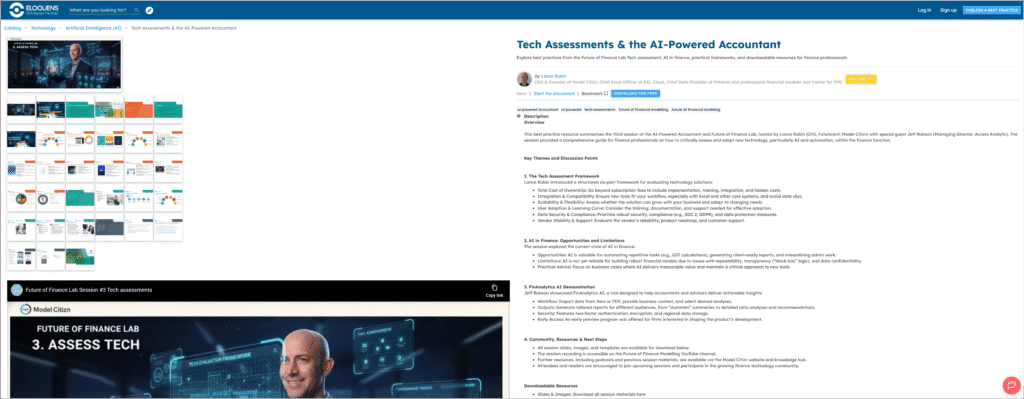
The session was also recorded and is available to be viewed on YouTube.

Want to discuss how AI can transform your finance function?
Get in touch with Model Citizn to learn more about our approach to AI-powered financial modelling and strategic implementation.
Want to take action? You can by clicking here
We have just launched our AI-Powered series of free fortnightly sessions to unpack all the hype and provide solid foundations for finance professionals.
Join our Friday Future of Finance Lab by registering here.
Friday’s Future of Finance Lab

AI-Powered Accountant
Join our fortnightly community where finance professionals share insights, solve real challenges, and stay ahead of the AI revolution (max 50 attendees).
Key Benefits:
✅ Live Problem Solving – Bring work challenges
✅ Expert Insights – Practitioners not trainers
✅ AI Integration – Leverage AI in finance
✅ Networking – like-minded professionals
✅ Zero Cost – Completely free, always
What You’ll Get:
✅ – Fortnightly Focus Areas in the following areas
✅ – Financial Modeling Deep Dives
✅ – Data Analysis & Power BI Techniques
✅ – AI Applications in Finance
✅ – Open Forum & Case Studies Exclusive Resources
✅ – Meeting recordings and AI-generated summaries
✅ – Templates and tools shared during sessions
✅ – Resource library access
Who Should Attend:
✅ – Finance professionals wanting to upskill
✅ – Data analysts working with financial data
✅ – Anyone curious about AI in finance
✅ – Business leaders seeking data-driven insights
Buckle up and look forward to seeing you there!
AI Accounting Finance #CFO #FinancialModeling #AIAdoption #FutureOfWork