

Background
The Future of Finance Is Human: Why Mindset May Be the Most Important Skill for Accountants
Opening Summary
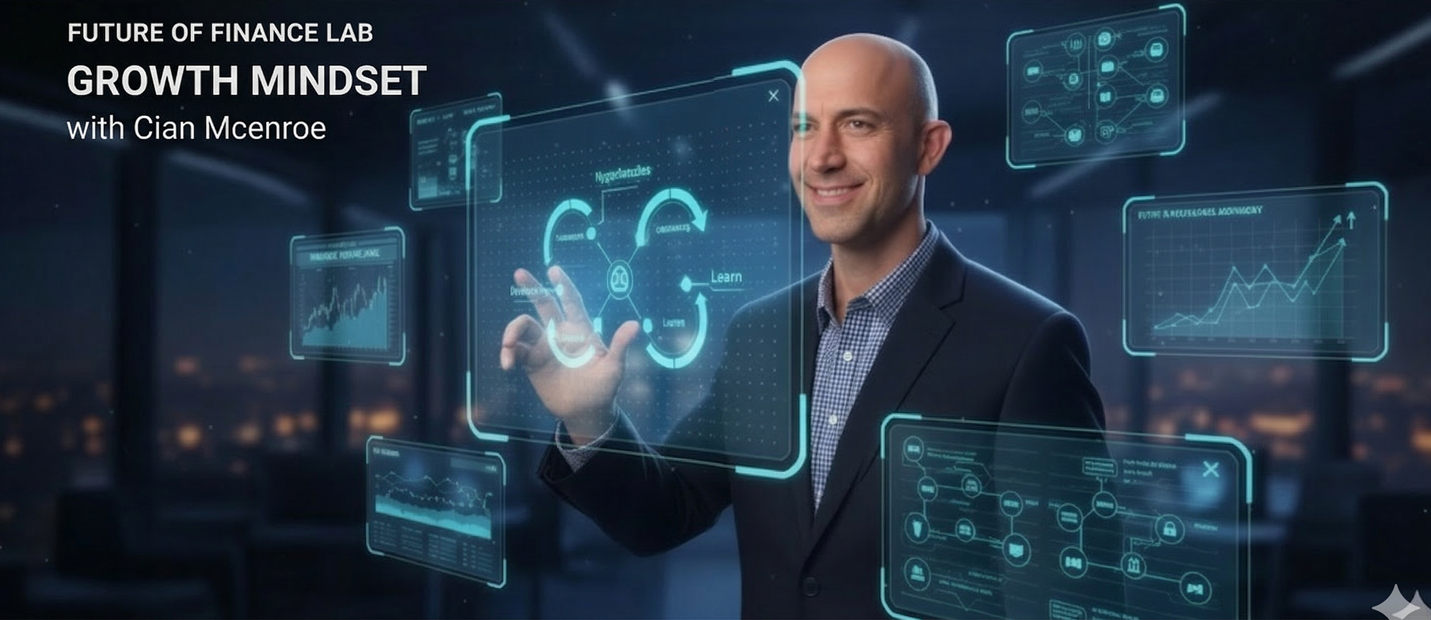
Exploring Mindset in Session 8 of the Future of Finance Lab
In Session 8 of the Future of Finance Lab, the conversation shifted away from technology and into something even more fundamental: mindset. While the series has explored tools, automation, Excel, AI concepts, and data-driven workflows, this session focused on the psychological and human side of the profession.
Host Lance Rubin was joined by psychologist and organisational change consultant Cian McEnroe to unpack one of the most overlooked pillars of the AI‑powered accountant: growth mindset and human skills. The discussion explored how finance professionals can navigate uncertainty, manage the psychological impact of rapid technological change, and build the self-awareness required to thrive in the evolving world of finance.
While AI and automation will reshape workflows, the session highlighted a deeper truth: the most important transformation may be how finance professionals think about themselves, their capabilities, and their role in the future of work.
Golden Nugget
“AI will automate tasks — but it cannot replace self-awareness, emotional intelligence, and purpose. Finance professionals who cultivate a growth mindset and invest in human skills will be best positioned to thrive in the AI-powered future.”
Key Insights and Frameworks
The Framework Behind the AI-Powered Accountant
Throughout the Future of Finance Lab series, Rubin has introduced a framework for navigating the changing finance profession: HACK — Hygiene, Automation, Capability, and Knowledge.
This framework helps finance professionals think about how they prepare themselves and their organisations for an increasingly automated and AI-enabled environment.
Hygiene refers to disciplined ways of working — clean data, well-designed processes, and structured information. Without this foundation, automation and AI cannot function effectively.
Automation focuses on removing repetitive and manual tasks through technology. From Excel automation to Power BI and emerging AI tools, automation frees finance professionals from time-consuming operational work.
Capability centres on developing new skills. As the profession evolves, finance teams must build capabilities that extend beyond traditional accounting and reporting.
Knowledge emphasises continuous learning and knowledge sharing. The pace of technological change means finance professionals must constantly update how they work and what they know.
However, Session 8 introduced an additional dimension that sits across all four elements: mindset and human skills.
Technical skills remain important, but the ability to adapt, collaborate, communicate, and learn continuously is becoming equally critical.
As Rubin noted during the session:
“It’s not just about the technical skills. It’s about what we as humans will do as we automate more of the work.”
Why Change Feels Like a Threat
One of the most powerful insights from the session came from McEnroe’s explanation of how the brain responds to change.
Human brains are not naturally wired for innovation. They are wired for survival.
McEnroe described how our brains evolved in layers, with different systems influencing our behaviour:
- The nervous system, which constantly scans the environment for danger
- The limbic system, which acts as the brain’s emotional security guard
- The prefrontal cortex, responsible for rational thinking and reflection
While we often believe we make rational decisions, much of our behaviour is driven by deeper, unconscious processes.
As McEnroe explained:
“There’s actually four times more real estate in the brain dedicated to looking for threat than there is for reward.”
This evolutionary bias means that new technologies or changes to how we work can easily trigger a defensive reaction. AI, automation, and digital transformation are often perceived — consciously or unconsciously — as threats.
Understanding this biological reality helps explain why change initiatives frequently encounter resistance.
The Three Psychological Needs That Shape Behaviour
McEnroe introduced a simple but powerful framework for understanding workplace resistance to change. At the core are three fundamental psychological needs.
Security
Security relates to safety and stability. In the modern workplace, this often translates into financial security and job stability.
When professionals believe new technologies could threaten their role or livelihood, the brain’s threat detection system activates.
Control
Control refers to our ability to influence our environment and make decisions.
When organisational change removes familiar processes or introduces unfamiliar tools, people may feel they are losing control.
Status
Status is the need to feel respected and valued by others.
For finance professionals who have built expertise around certain systems or processes, automation can feel like a threat to their professional identity.
Rubin illustrated this dynamic with a common workplace scenario:
“You show someone a tool that reduces a task from a day to an hour — and instead of excitement, you get resistance.”
Often, the resistance is not about the technology itself. Instead, it reflects deeper concerns about status, relevance, or job security.
Understanding these underlying drivers allows leaders to approach change with greater empathy and effectiveness.
Fixed Mindset vs Growth Mindset
The discussion also explored the concept of growth mindset, originally developed by psychologist Carol Dweck.
A fixed mindset assumes that intelligence and abilities are static. Individuals operating from this mindset often try to protect their reputation by avoiding challenges or situations where they might fail.
A growth mindset, by contrast, assumes that abilities can be developed through learning and effort.
McEnroe described this shift as a powerful change in perception:
“Growth mindset is the belief that our capacities and talents can be improved over time.”
This perspective transforms how individuals respond to change.
Instead of viewing challenges as threats, they become opportunities to learn and grow.
For finance professionals navigating AI and automation, this mindset shift may be one of the most important professional capabilities they can develop.
The Power of Attention and Self-Awareness
Another key theme from the session was the role of attention.
In an environment filled with global uncertainty, economic volatility, and rapid technological change, it is easy for professionals to remain in a constant state of stress.
However, McEnroe emphasised that individuals have more control than they often realise.
“Each one of us has a decision about where we put our attention.”
If attention is constantly focused on threats — job disruption, geopolitical instability, economic uncertainty — the brain remains locked in defensive mode.
However, focusing attention on learning, curiosity, and meaningful work can activate the brain’s more reflective and creative capabilities.
Rubin shared a personal example of how he manages this balance:
“For me, it’s getting out into nature and going for a run. It’s being present in the moment.”
These moments of reflection create space for deeper thinking and better decision-making.
Discovering Purpose in the Future of Work
Perhaps the most powerful concept explored in the session was purpose.
Purpose is often misunderstood as a career goal or professional achievement. McEnroe offered a more personal interpretation.
“Purpose is what truly lights you up.”
When individuals align their work with what energises them, work becomes more meaningful and sustainable.
Rubin’s own journey illustrates this principle. After leaving corporate life, he built a business dedicated to helping finance professionals work more effectively through better technology and processes.
“I realised there were better ways to do things.”
This sense of purpose now drives the Future of Finance Lab series itself — creating a platform to help finance professionals learn, evolve, and adapt.
Practical Takeaways and Actionable Strategies
Session 8 offered several practical insights for professionals navigating the future of finance.
Recognise the psychology behind resistance to change.
Many barriers to innovation are driven by perceived threats to security, control, or status.
- Adopt a growth mindset.
- View new technologies and changing roles as opportunities for development rather than risks.
- Invest in human skills.
- Communication, storytelling, empathy, and critical thinking are becoming increasingly valuable as automation expands.
- Create space for reflection.
- Regular moments of stillness and reflection help calm the nervous system and enable clearer thinking.
- Follow what energises you.
- Purpose and passion are powerful drivers of resilience and long-term success.
All of these sound simple and practical at first, but implementing them can be challenging. Take each out slowly and progressively over time.
Notable Examples and Case Studies
Why People Resist Better Tools
One of the most relatable examples discussed in the session came from Rubin’s experience introducing automation and improved workflows in corporate finance teams.
When finance professionals are shown a tool that can reduce a task from a full day of work to less than an hour, the expected reaction might be enthusiasm. In reality, the response is often resistance.
Rubin explained that the reaction rarely has anything to do with the quality of the tool itself. Instead, it reflects deeper psychological concerns.
“If a task that took someone a day suddenly takes an hour, that creates a threat. They start wondering what they’ll do with the rest of the day.”
The perceived risk can affect several psychological needs simultaneously:
- Status: If software performs tasks faster, does it reduce the value of the individual’s expertise?
- Security: Could greater efficiency eventually threaten job stability?
- Control: Does adopting the new tool remove familiar ways of working?
Understanding these dynamics helps explain why change initiatives often stall even when the benefits appear obvious.
Career Transformation Through Purpose
Rubin also shared a personal example of how purpose can reshape a professional path.
After years working in corporate finance environments, he realised that there were better ways for finance professionals to work — particularly through automation, improved modelling techniques, and more intelligent use of technology.
Rather than remaining within the traditional corporate structure, Rubin chose to build his own business focused on helping finance professionals modernise how they work.
“I realised there were better ways to do things, and the best way for me to do that was outside the corporate confines.”
The decision was not necessarily easier or less risky. Running a business involves uncertainty and pressure. However, the work aligned strongly with his sense of purpose — helping finance professionals evolve their capabilities.
This example illustrates one of the central themes of the session: when work aligns with purpose, challenges become far more meaningful and sustainable.
Personal Practices That Support Growth
Another practical example emerged when discussing how professionals manage the constant mental noise of modern work.
Rubin described how running outdoors helps him disconnect from work and reconnect with the present moment.
“It’s just getting out into nature and running… trying to be present in the moment.”
While simple, practices like exercise, time in nature, or reflective thinking play an important role in calming the nervous system and shifting the brain out of constant threat mode.
In a world of continuous digital stimulation and professional pressure, these practices help finance professionals maintain clarity, creativity, and resilience.
These examples reinforce a key message from the session: understanding the human side of change is just as important as understanding the technology itself.
Important Quotes from the Session
Several powerful insights emerged throughout the discussion, capturing the deeper themes around mindset, change, and the future of the finance profession.
On the human side of technological change
- “It’s not just about the technical skills. It’s about what we as humans are going to do as we automate more of the work.”— Lance Rubin. This quote captures the central message of the session: as AI and automation remove repetitive tasks, the differentiator for finance professionals will increasingly be their human capabilities.
On how our brains respond to change
- “There’s actually four times more real estate in the brain dedicated to looking for threat than there is for reward.”— Cian McEnroe. This observation explains why many professionals instinctively resist new technologies or processes. Our brains are biologically wired to prioritise survival over opportunity.
On the meaning of the growth mindset
- “Growth mindset is the belief that our capacities and talents can be improved over time.”— Cian McEnroe. Rather than seeing abilities as fixed, this perspective reframes challenges as opportunities to learn, adapt, and evolve.
On personal agency in uncertain times
- “Each one of us has a decision about where we put our attention.”— Cian McEnroe. In an environment filled with global uncertainty and technological disruption, the ability to direct attention toward growth and learning becomes a powerful skill.
On purpose and meaningful work
- “Purpose is what truly lights you up.”— Cian McEnroe. Purpose is not limited to career achievements or titles. It reflects the activities and contributions that energise individuals and give deeper meaning to their work.
On finding better ways to work
- “I realised there were better ways to do things.”— Lance Rubin. This insight reflects the spirit behind the Future of Finance Lab series itself — helping finance professionals explore more effective ways of working in an AI‑enabled world.
Conclusion: The Future of Finance Lab in Perspective
Session 8 of the Future of Finance Lab served as an important reminder that the future of finance is not purely technical. While automation, AI, and advanced analytics are transforming the profession, the professionals who thrive will be those who develop the human capabilities that technology cannot replace.
Growth mindset, self-awareness, emotional intelligence, and purpose are becoming critical competencies alongside Excel, data, and AI literacy. As finance professionals navigate this transformation, understanding both the tools of the future and the psychology behind change will be essential.
The Future of Finance Lab continues to explore these themes, helping finance professionals build the mindset, skills, and frameworks needed to thrive in an AI‑powered world.
Call to Action
Curious to see how AI is reshaping finance, model by model?
Explore the full Future of Finance Lab series for in-depth discussions, real-world experiments, and practical strategies to future-proof your finance function. Stay tuned for more sessions in 2026 as we continue to chart the evolving landscape of technology and finance.
For the full session recording, downloadable models, and additional resources, visit our Knowledge Hub or connect with us on LinkedIn and YouTube.
Ready to future-proof your finance skills?
Looking Ahead
The Future of Finance Lab is more than a webinar—it’s an interactive community dedicated to learning, sharing, and growing together. We invite you to join our next session, connect with peers, and continue building the skills that will define the future of finance.
For resources, recordings, and more, visit our Knowledge Hub and stay tuned for further updates!
You can find more content on Eloquens, including the FREE slides.

The session was also recorded and is available to be viewed on YouTube.

Want to discuss how AI can transform your finance function? Get in touch with Model Citizn to learn more about our approach to AI-powered financial modelling and strategic implementation.
Want to take action? You can by clicking here
We just launched our AI-Powered series of FREE fortnightly sessions to unpack all the hype and give solid foundations to finance professionals. Join our Friday Future of Finance Lab by registering here.
Friday’s Future of Finance Lab

AI-Powered Accountant
Join our fortnightly community where finance professionals share insights, solve real challenges, and stay ahead of the AI revolution (max 50 attendees).
Key Benefits:
✅ Live Problem Solving – Bring work challenges
✅ Expert Insights – Practitioners not trainers
✅ AI Integration – Leverage AI in finance
✅ Networking – like-minded professionals
✅ Zero Cost – Completely free, always
What You’ll Get:
✅ – Fortnightly Focus Areas in the following areas
✅ – Financial Modeling Deep Dives
✅ – Data Analysis & Power BI Techniques
✅ – AI Applications in Finance
✅ – Open Forum & Case Studies Exclusive Resources
✅ – Meeting recordings and AI-generated summaries
✅ – Templates and tools shared during sessions
✅ – Resource library access
Who Should Attend:
✅ – Finance professionals wanting to upskill
✅ – Data analysts working with financial data
✅ – Anyone curious about AI in finance
✅ – Business leaders seeking data-driven insights
Buckle up and look forward to seeing you there!
AI Accounting Finance #CFO #FinancialModeling #AIAdoption #FutureOfWork