

Background
The Next Frontier: How 5G Modeling and AI Are Transforming Financial Modeling Forever
Opening Summary
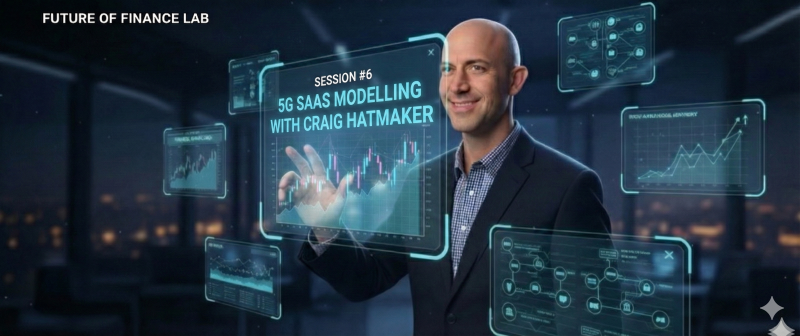
In the first session of the Future of Finance Lab’s 2026 series, participants were treated to a deep dive into the cutting edge of financial modeling. Led by Lance Rubin, CFO of FutureRent, and featuring Excel MVP Craig Hatmaker, the session explored the evolution of modeling frameworks, the game-changing impact of 5G modeling, and the practical integration of AI tools. Attendees gained actionable strategies to reduce errors, streamline workflows, and future-proof their finance functions, all while maintaining the rigour and transparency demanded by today’s business environment. This session not only capped off a series dedicated to advancing finance professionals’ skills but also set the stage for the next era of intelligent, reliable, and scalable financial modeling.
Fortnightly Nugget
“Reducing the number of formulas in your model isn’t just about efficiency—it’s about risk. A single 5G Lambda can replace thousands of traditional formulas, slashing error rates by over 90% and making your models more robust, auditable, and future-ready.”
Key Insights and Frameworks
The HACK Framework and the Rise of the AI-Powered Accountant
The session opened with Lance Rubin introducing the AI-powered accountant’s six-stage journey, built on the HACK framework: Hygiene, Automation, Capability, and Knowledge. “You can’t get good at using AI if you don’t have hygiene, if you don’t embrace automation. You build your capability and ultimately your knowledge and sharing,” Lance emphasized. This approach underscores the need for strong foundational practices before layering on advanced tools like AI and automation.
The Evolution to 5G Modeling
Craig Hatmaker traced the history of spreadsheet modeling from the earliest days of VisiCalc to today’s fifth-generation (5G) modeling. The breakthrough? Marrying Excel’s Dynamic Arrays and Lambda functions to create reusable, error-resistant formulas. “It’s a totally different way of thinking about building models. Think of it like this: you’re using perfect pre-made walls instead of laying every single brick yourself,” explained Craig.
He highlighted the measurable benefits: “One formula can replace thousands. This is not an opinion. It is measurable fact.” In a real-world SaaS model example, the traditional approach required nearly 20,000 formulas, while the 5G approach reduced this to just 944—a 95% reduction. This not only slashes the risk of errors but also dramatically simplifies audits and model maintenance.
The Power of Dynamic Arrays and Lambdas
Dynamic Arrays allow for flexible, scalable models that adapt as data grows. However, they initially struggled with common financial modeling challenges like “corkscrews” (where closing balances become opening balances in subsequent periods, creating circular references). The introduction of Lambda functions solved this, enabling complex calculations—like revolving credit facilities or depreciation schedules—to be handled in a single, transparent formula.
Craig explained, “Lambda could take the dynamic arrays, put them in a structure so that we can do a corkscrew with one function, no problem. One function that replaces at least four lines of formulas.”
Practical Takeaways and Actionable Strategies
1. Eliminate Hard Coding and Inconsistent Formulas
Both Lance and Craig stressed the dangers of hard-coding and inconsistent formulas, which remain widespread in client models. By adopting 5G modeling, finance teams can enforce consistency and reduce manual intervention. “Hard-coding is like pouring sand into a computer—it renders the model non-flexible,” Lance warned.
2. Use Pre-Tested, Documented Functions
5G modeling leverages pre-tested Lambda functions that are transparent and well-documented. Users don’t need to understand the underlying Lambda code—just as they don’t need to know how the SUM function is written in C#. “If you know how to use SUM, you have the basic skills to do 5G modeling,” Craig assured.
3. Shift to Data-Driven Models
The move from formula-heavy to data-driven models means more constant cells and less formula complexity. This shift supports better performance, easier scaling, and more reliable outputs. “You can have any number of periods, accounts, or budget items without modeler intervention,” Craig demonstrated in his budget modeling example.
4. Focus on Model, Not Just Formula, Complexity
While Lambda functions may be complex, the overall model complexity drops dramatically. Craig explained, “You have formula complexity, which is looking at one formula, and then you have model complexity, which is the sum of all formula complexities. My Lambdas probably don’t have that complexity score. So in one way, you can say, yeah, they’re more complex. Another way, you can say, they’re less complex. Because you’re only entering one function instead of a whole set of formulas.”
5. Embrace Modern Auditing Approaches
Traditional cell-by-cell inspection is time-consuming and expensive. The session highlighted the shift toward scenario-based testing and comparison with “proven winner” models, as practised by leading firms like OPERIS. “Testing is superior to cell-by-cell inspection,” Craig noted, advocating for a more efficient, outcome-focused audit process.
Notable Examples and Case Studies
- SaaS Model Transformation: A client’s three-way SaaS model, originally built with 19,836 formulas, was re-engineered using a combination of AI-generated and 5G Lambdas, reducing formulas to 944 and unique formulas to just a handful. The risk of formula errors dropped dramatically, and the model became easier to audit and maintain.
- Industry Acceptance: 5G models have been vetted and accepted by major firms like BDO and Deloitte, with hundreds of users and dozens of companies adopting the approach.
- Budgeting Demo: Craig’s demonstration showed how a single Lambda function could handle zero-based and rotating budgets for any number of accounts and periods, with outputs instantly adapting to user inputs.
Important Quotes from the Session
- “If you make mistakes, it can kill your career. I’ve made mistakes, but fortunately, I had people review my work and then find them before they went out into the world.” – Craig Hatmaker
- “The biggest risk in modeling is formulas and therefore the biggest way you can reduce that risk is reducing the number of formulas.” – Lance Rubin
- “With this, they love it because that can’t happen—just so inconsistent formulas not being able to happen saves…not only preventing the modeler from making a mistake but also preventing the user from making a mistake that they shouldn’t be making.” – Craig Hatmaker
- “AI building models right now, still not fantastic. Learn modern Excel first. That’s probably the key thing I’d say.” – Lance Rubin
Conclusion: The Future of Finance Lab in Perspective
This first session of 2026 encapsulated the mission of the Future of Finance Lab: to empower finance professionals with the latest tools, frameworks, and mindsets needed to thrive in a rapidly evolving landscape. By demystifying 5G modeling, showcasing practical AI integrations, and emphasizing the importance of foundational skills, the Lab has equipped its community to lead the next wave of financial innovation.
As Lance closed, “This journey is going to continue to evolve and accelerate. I appreciate it.” The message is clear: the future belongs to those who embrace change, experiment boldly, and commit to continuous learning.
Call to Action
Curious to see how AI is reshaping finance, model by model?
Explore the full Future of Finance Lab series for in-depth discussions, real-world experiments, and practical strategies to future-proof your finance function. Stay tuned for more sessions in 2026 as we continue to chart the evolving landscape of technology and finance.
For the full session recording, downloadable models, and additional resources, visit our Knowledge Hub or connect with us on LinkedIn and YouTube.
Ready to future-proof your finance skills?
Looking Ahead
The Future of Finance Lab is more than a webinar—it’s an interactive community dedicated to learning, sharing, and growing together. We invite you to join our next session, connect with peers, and continue building the skills that will define the future of finance.
For resources, recordings, and more, visit our Knowledge Hub and stay tuned for further updates!
You can find more content on Eloquens, including the FREE slides, Excel workbooks and premium content, including all AI-built models and the human-built solution and a comparison file can be found here.
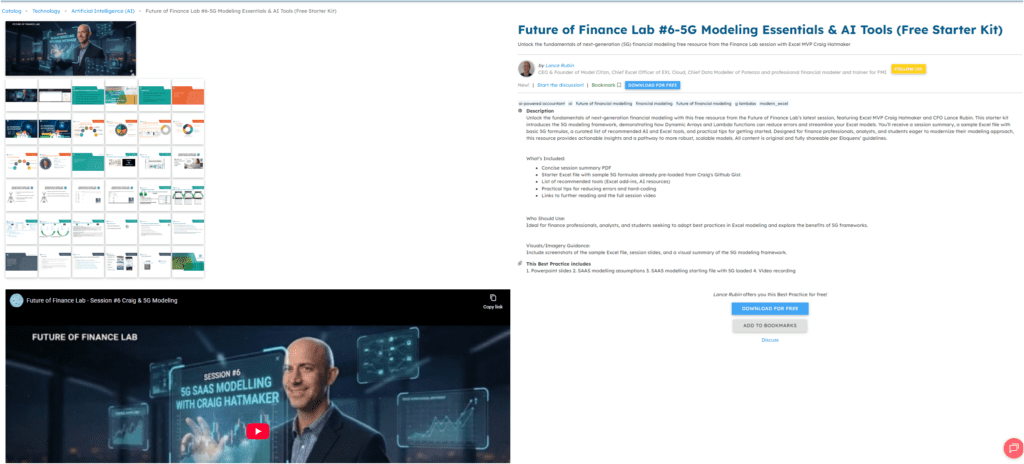
The session was also recorded and is available to be viewed on YouTube.

Want to discuss how AI can transform your finance function? Get in touch with Model Citizn to learn more about our approach to AI-powered financial modelling and strategic implementation.
Want to take action? You can by clicking here
We just launched our AI-Powered series of FREE fortnightly sessions to unpack all the hype and give solid foundations to finance professionals. Join our Friday Future of Finance Lab by registering here.
Friday’s Future of Finance Lab
AI-Powered Accountant
Join our fortnightly community where finance professionals share insights, solve real challenges, and stay ahead of the AI revolution (max 50 attendees).
Key Benefits:
✅ Live Problem Solving – Bring work challenges
✅ Expert Insights – Practitioners not trainers
✅ AI Integration – Leverage AI in finance
✅ Networking – like-minded professionals
✅ Zero Cost – Completely free, always
What You’ll Get:
✅ – Fortnightly Focus Areas in the following areas
✅ – Financial Modeling Deep Dives
✅ – Data Analysis & Power BI Techniques
✅ – AI Applications in Finance
✅ – Open Forum & Case Studies Exclusive Resources
✅ – Meeting recordings and AI-generated summaries
✅ – Templates and tools shared during sessions
✅ – Resource library access
Who Should Attend:
✅ – Finance professionals wanting to upskill
✅ – Data analysts working with financial data
✅ – Anyone curious about AI in finance
✅ – Business leaders seeking data-driven insights
Buckle up and look forward to seeing you there!
AI Accounting Finance #CFO #FinancialModeling #AIAdoption #FutureOfWork