

Background
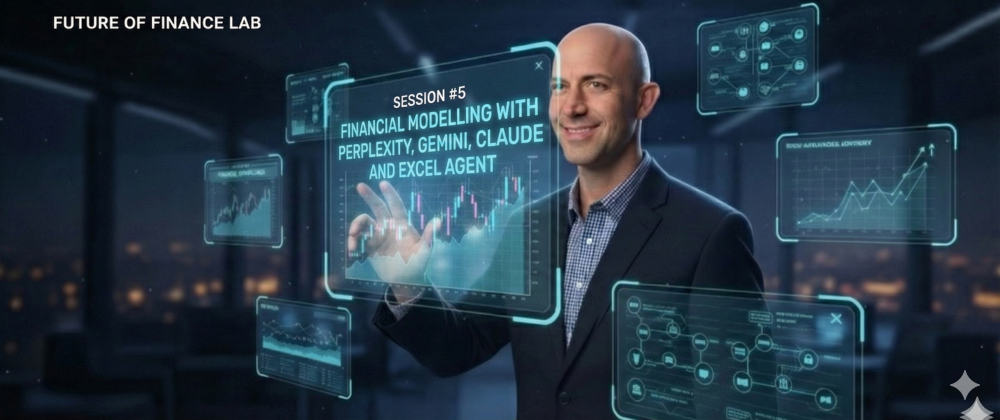
The final 2025 session of the Future of Finance Lab brought together finance professionals, AI analysts, and technology enthusiasts to reflect on the rapidly evolving intersection of artificial intelligence and financial modeling.
Hosted by Lance Rubin, CFO and founder of Model Citizn, with guest Jamie Evans, Senior AI Analyst at JK Tech Global, the session offered a candid exploration of the opportunities and persistent challenges that AI presents in the world of finance.
From hands-on demonstrations of leading AI tools to open discussions on data governance and professional skepticism, this session distilled a year’s worth of experimentation and learning into actionable insights for the finance community.
Fortnightly Nugget
Each session of the Future of Finance Lab features a “nugget”—a practical insight or experiment. For this finale, the spotlight was on leveraging AI to automate the creation of a project finance waterfall model. Lance challenged Anthropic’s Claude to generate an Excel model and accompanying documentation, then used Microsoft Copilot in Excel to enhance the output. The result? A promising, if imperfect, demonstration of how AI can accelerate model development, but also a reminder that human oversight remains indispensable.
Key Insights and Frameworks
The Six Pillars of Finance Transformation
The Lab’s foundational framework—hack, Excel, process, tech, AI, growth mindset, and human—served as a lens for evaluating the latest AI tools. The session emphasized that successful adoption of AI in finance requires balancing technical innovation with human judgment and continuous learning.
AI’s Contextual Blind Spots
A recurring theme was the inability of AI models to fully understand business context. As Jamie Evans noted, “The biggest issue I found with AI is that it doesn’t understand the context the way humans do.
It’ll generate formulas that look right, but that don’t make business sense. You need to challenge every output, validate the logic, and catch mistakes before they become decisions.”
This insight underscores the need for finance professionals to remain vigilant and critical when using AI-generated outputs.
Hallucinations and Overconfidence
Both Lance and Jamie highlighted the phenomenon of AI “hallucinations”—confidently producing incorrect or misleading results. Lance remarked, “Hallucinations are still a big problem.
Overcomplicating things as well. It might be wide, but do we actually understand how it got to the formulas and logic?” The group agreed that while AI can speed up routine tasks, it must be treated as a tool, not a replacement for professional expertise.
Data Governance and Trust
The session tackled pressing questions about data privacy and compliance. Jamie raised concerns about where data is processed when using cloud-based AI tools: “If you’re dragging and dropping to the web, who’s going to trust? The hurdle Microsoft’s going to have is trust. Where’s my data going?” Lance added that only organizations with significant resources can afford to deploy AI entirely within their own secure environments, and that most users must weigh convenience against governance risks.
Practical Takeaways and Actionable Strategies
- Always Validate AI Outputs
- AI-generated models should never be accepted at face value. Professionals must rigorously check formulas, logic, and assumptions, especially before using models for decision-making or external reporting.
- Experiment with Multiple Tools
- The session demonstrated that no single AI tool is universally superior. Lance and Jamie tested Perplexity, Gemini, ChatGPT, Claude, and Microsoft’s Excel Agent, finding wide variability in results. For instance, Gemini performed best when given an Excel file rather than a PDF, while Excel Agent showed marked improvement over just a few months, scoring up to 86% on a custom assessment.
- Refine Prompts and Model Selection
- Effective prompt engineering is crucial. Jamie’s experience showed that explicit, well-structured prompts and careful model selection can significantly improve outcomes. He advised, “Structure your prompts in a way that the LLM will tell you at the start whether or not it can do it.”
- Prioritize Data Governance
- Finance teams must understand where and how their data is processed. Tools with SOC 2 compliance and robust encryption are preferable. For highly sensitive data, consider on-premises or private cloud solutions, despite higher costs.
- Upskill Alongside AI
- AI is best viewed as an assistant that augments, not replaces, human capability. Overreliance can erode core modeling skills. As Lance cautioned, “Build your skills alongside it with it, but make sure you’re not having too much dependency and reliance on it.”
- AI Prompt Engineering
- Train AI tools (like TabAI) to remember your preferences—e.g., “never hardcode, always show workings”—to reduce the risk of hallucinations or poor practices.
- Balance Complexity and Clarity
- Both hosts stressed the need to balance advancedfunctionality with model simplicity, tailored to the client’s readiness and understanding.
Notable Examples and Case Studies
- Project Finance Waterfall Model: Lance used Claude and Copilot to automate the creation of a complex project finance model, then assessed the outputs for completeness and accuracy. While the AI-generated model provided a solid starting point, it required significant manual refinement.
- Tool Benchmarking: The team created a “leaderboard” to score various AI tools on their ability to build a full three-way financial model. Excel Agent’s performance jumped from 25% to 86% in just one month, illustrating the rapid pace of AI development.
- Data Governance in Practice: The discussion highlighted how major banks are deploying their own internal LLMs to ensure data privacy, while most organizations must rely on the assurances of vendors like Microsoft or Anthropic.
Important Quotes from the Session
- “You can’t just blindly trust it… There’s going to have to be someone that’s going to have to supervise it.” – Jamie Evans
- “Hallucinations are still a big problem. Overcomplicating things as well… It’s getting a lot better at some of the tasks, but it still lacks some of that business context, lacks some of the deeper nuances.” – Lance Rubin
- “If you’re going to be using some of these tools, you’ve got to make sure that they have the required governance and compliance around that tool.” – Lance Rubin
- “The Liars Club seems to be anything that references GPT. It sounds like a human, but it’s not doing anything.” – Jamie Evans
Conclusion: The Future of Finance Lab in Perspective
The final 2025 session of the Future of Finance Lab encapsulated a year of experimentation, skepticism, and optimism about AI’s role in finance. The consensus: AI is advancing rapidly, but it is not yet ready to replace the skilled financial modeler. Instead, it offers powerful augmentation—accelerating routine tasks, enabling new forms of analysis, and freeing up professionals to focus on higher-value work. However, the need for human oversight, rigorous validation, and robust data governance remains paramount.
As Lance summarized, “The tools are getting better. But I still find if I start to look below the surface of what it actually produced and the content, is it actually ready for me to use? It probably isn’t. So I still say as a professional financial [modeler], the tools are getting better. But they’re not quite there yet.”
Call to Action
Curious to see how AI is reshaping finance, model by model?
Explore the full Future of Finance Lab series for in-depth discussions, real-world experiments, and practical strategies to future-proof your finance function. Stay tuned for more sessions in 2026 as we continue to chart the evolving landscape of technology and finance.
For the full session recording, downloadable models, and additional resources, visit our Knowledge Hub or connect with us on LinkedIn and YouTube.
Ready to future-proof your finance skills?
Looking Ahead
The Future of Finance Lab is more than a webinar—it’s an interactive community dedicated to learning, sharing, and growing together. We invite you to join our next session, connect with peers, and continue building the skills that will define the future of finance.
For resources, recordings, and more, visit our Knowledge Hub and stay tuned for further updates!
You can find more content on Eloquens, including the FREE slides, Excel workbooks and premium content, including all AI-built models and the human-built solution and a comparison file can be found here.
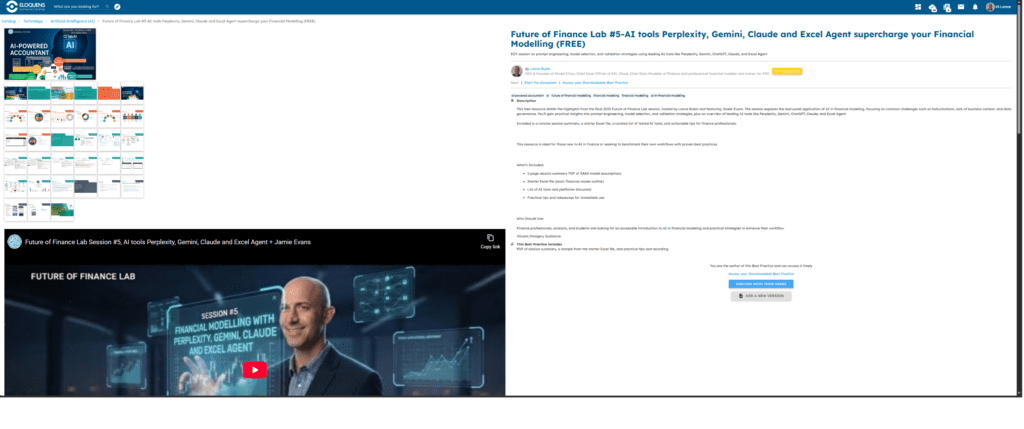
The session was also recorded and is available to be viewed on YouTube.

Want to discuss how AI can transform your finance function? Get in touch with Model Citizn to learn more about our approach to AI-powered financial modelling and strategic implementation.
Want to take action? You can by clicking here
We just launched our AI-Powered series of FREE fortnightly sessions to unpack all the hype and give solid foundations to finance professionals. Join our Friday Future of Finance Lab by registering here.
Friday’s Future of Finance Lab

AI-Powered Accountant
Join our fortnightly community where finance professionals share insights, solve real challenges, and stay ahead of the AI revolution (max 50 attendees).
Key Benefits:
✅ Live Problem Solving – Bring work challenges
✅ Expert Insights – Practitioners not trainers
✅ AI Integration – Leverage AI in finance
✅ Networking – like-minded professionals
✅ Zero Cost – Completely free, always
What You’ll Get:
✅ – Fortnightly Focus Areas in the following areas
✅ – Financial Modeling Deep Dives
✅ – Data Analysis & Power BI Techniques
✅ – AI Applications in Finance
✅ – Open Forum & Case Studies Exclusive Resources
✅ – Meeting recordings and AI-generated summaries
✅ – Templates and tools shared during sessions
✅ – Resource library access
Who Should Attend:
✅ – Finance professionals wanting to upskill
✅ – Data analysts working with financial data
✅ – Anyone curious about AI in finance
✅ – Business leaders seeking data-driven insights
Buckle up and look forward to seeing you there!
AI Accounting Finance #CFO #FinancialModeling #AIAdoption #FutureOfWork