

Background
Riding the AI Wave: How the Future of Finance Lab Redefined Financial Modeling for the Next Generation
Opening Summary
The second session of 2026 in the Future of Finance Lab brought together leading voices in financial modeling and technology to dissect the rapidly evolving intersection of artificial intelligence (AI) and finance.
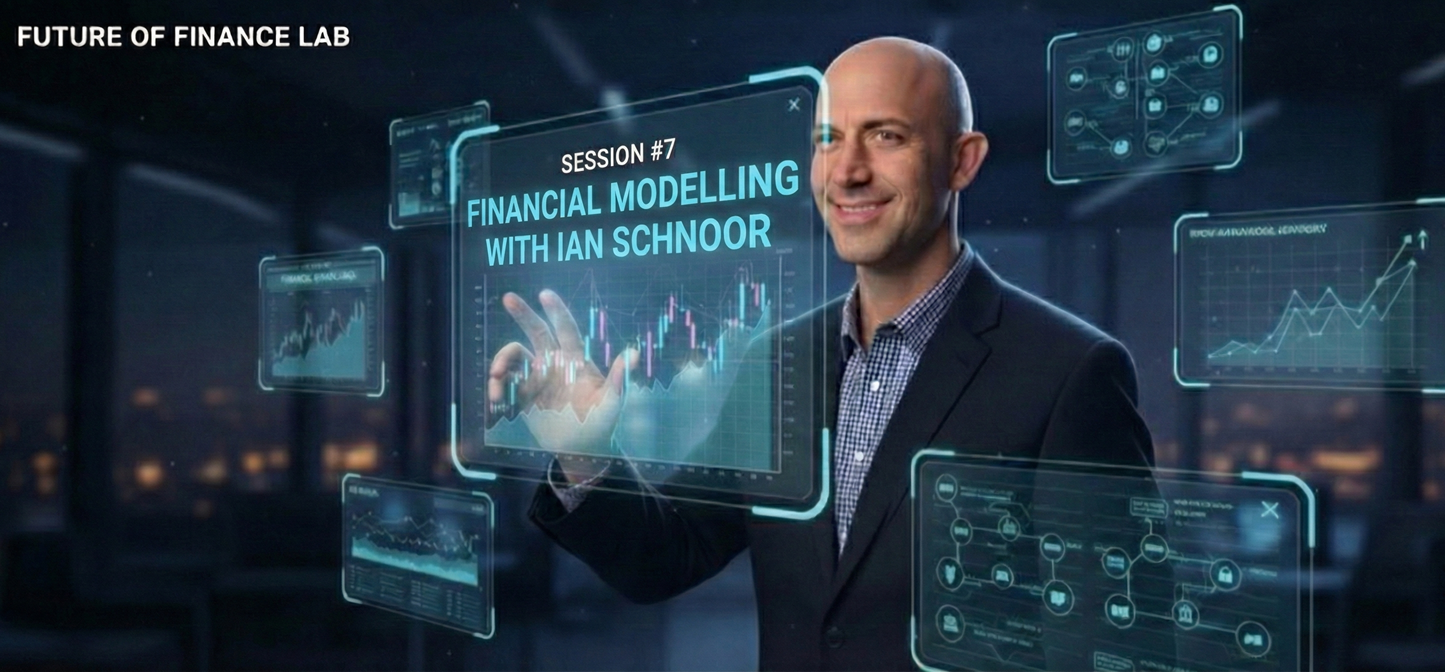
Hosted by Lance Rubin, CEO Model Citizn, and featuring Ian Schnoor, Director of the Financial Modeling Institute, the conversation explored the realities and myths of AI-powered modeling, the enduring importance of foundational skills, and the practical strategies finance professionals must adopt to thrive in an era where automation and augmentation are reshaping the landscape.
This session, rich with anecdotes, frameworks, and hard-won insights, served as both a capstone and a launchpad for ongoing adaptation in the profession.
Session Nugget
“AI will not replace the finance professional—but finance professionals who embrace AI will replace those who don’t. The future belongs to those who blend technical mastery with human judgment, using AI as a tool for augmentation, not substitution.”
Key Insights and Frameworks
The Six Pillars of the AI-Powered Accountant
Lance Rubin opened the session by reiterating the six pillars for the modern finance professional: Excel fluency, data processing, technology assessment, AI conceptual understanding, growth mindset, and human skills. While AI and automation are transforming workflows, the panel emphasized that Excel remains the backbone of financial modeling, and mastery of both the tool and the underlying concepts is non-negotiable.
Automation vs. Augmentation: The New Paradigm
A central theme was the distinction between automation (“do my job for me”) and augmentation (“make me better at my job”). Ian Schnoor cited recent research from Anthropic, noting that while automation was initially dominant, augmentation has now taken the lead in AI usage. “If you already have great skills and can use AI to get better, faster, stronger—that’s where the greatest success will come from,” Ian explained. This shift underscores the need for finance professionals to deepen their expertise rather than rely on AI as a crutch.
The Evolution of Modeling Tools
The discussion traced the evolution of modeling from the green-screen days of Lotus 1-2-3 to the dynamic, AI-enhanced capabilities of modern Excel.
Notably, the arrival of WYSIWYG (What You See Is What You Get) interfaces in the 1990s marked a turning point, making models more visual and communicative. Today, tools like TabAI, Copilot, and Claude are pushing boundaries, but the consensus is clear: while these tools can accelerate and enhance, they cannot yet replicate the nuanced, context-driven judgment required for complex, Wall Street-grade models.
Practical Takeaways and Actionable Strategies
1. Master the Fundamentals
Both speakers stressed that foundational modeling skills—design, structure, and understanding of three-statement models—are more important than ever. “Learn the foundations now, get the core skills, because they matter more now than ever before,” Lance urged. AI can assist, but it cannot replace the need for human oversight and critical thinking.
2. Use AI as a Partner, Not a Replacement
Ian shared that the most effective use of AI is as a “third-year associate”—capable, but still requiring supervision. “The only reason I can use these tools is because I know how to challenge it, how to prompt it, what to look for, how to call nonsense on it,” he recounted from a senior executive’s experience. Finance professionals must learn to audit, verify, and contextualize AI outputs.
3. Avoid Over-Complexity
AI tools sometimes generate unnecessarily complex formulas or solutions. “You can instruct it to do something more simply, but it is likely to still use tools and features that you might not be familiar with. You need to know how to challenge, understand, audit them and check them,” Ian advised. Simplicity and transparency in modeling remain paramount.
4. Prioritize Model Purpose and Communication
A model is a means to an end—a tool for insight, decision-making, and storytelling. “Financial modeling is your clay that you’re molding. It is your tool to get smart,” Ian said. The process of building and refining a model is as valuable as the output itself.
5. Embrace Lifelong Learning
The session highlighted the need for a growth mindset. As tools and technologies evolve, so too must the skills and approaches of finance professionals. Experiment, provide feedback to developers, and stay abreast of new capabilities.
Notable Examples and Case Studies
1. The Mod Squad Testing Approach:
Ian described how the Mod Squad (with Paul Barnhart and Giles) tests AI tools across different modeling scenarios—FP&A, eSports challenges, and classic corporate finance—revealing both strengths and limitations.
2. Real-World AI Adoption:
A senior finance executive likened Shortcut (an AI tool) to a “first-year analyst” and Claude to a “third-year associate,” illustrating the rapid progress but also the current need for human oversight.
3. Student Stock Pitch:
Ian recounted reviewing a first-year university student’s stock pitch, which was so sophisticated it could only have been produced with AI. The student’s inability to explain key decisions highlighted the dangers of over-reliance on automation.
Important Quotes from the Session
- “If people who don’t have good modeling or Excel skills start using these tools, they can find themselves in a really, really difficult place.” – Lance Rubin
- “All usage of AI right now can be categorized into two buckets: automation or augmentation. Over the last quarter, augmentation has taken the lead.” – Ian Schnoor
- “The only reason I can use these tools is because I know how to challenge it, how to prompt it, what to look for, how to call nonsense on it.” – Senior finance executive (via Ian)
- “You’re like the accountant that used to do their ledgers by hand and refused to evolve. You’re going to have to evolve.” – Ian Schnoor
- “A model is your tool to get smart… It’s the process of modeling that allows you to become really intelligent about an opportunity, a company, a project.” – Ian Schnoor
Conclusion: The Future of Finance Lab in Perspective
This 7th session of the Future of Finance Lab encapsulated the journey of finance professionals navigating the AI revolution.
While tools and technologies will continue to evolve at breakneck speed, the core message is timeless: technical skills, critical thinking, and human judgment are irreplaceable.
The Lab has consistently championed a balanced approach—embracing innovation while reinforcing the fundamentals.
As Lance put it, “AI is going to force us to be better at financial modeling in Excel… Don’t let AI win at replacing you. Learn the foundations now, get the core skills, because I actually think they matter more now than ever before.”
Call to Action
Curious to see how AI is reshaping finance, model by model?
Explore the full Future of Finance Lab series for in-depth discussions, real-world experiments, and practical strategies to future-proof your finance function. Stay tuned for more sessions in 2026 as we continue to chart the evolving landscape of technology and finance.
For the full session recording, downloadable models, and additional resources, visit our Knowledge Hub or connect with us on LinkedIn and YouTube.
Ready to future-proof your finance skills?
Looking Ahead
The Future of Finance Lab is more than a webinar—it’s an interactive community dedicated to learning, sharing, and growing together. We invite you to join our next session, connect with peers, and continue building the skills that will define the future of finance.
For resources, recordings, and more, visit our Knowledge Hub and stay tuned for further updates!
You can find more content on Eloquens, including the FREE slides, free Excel workbooks with AI prompts and validation and checks built by 3 different AI Tools (TAB AI, Claude and Co-pilot) including all AI-built solutions.
The session was also recorded and is available to be viewed on YouTube.

Want to discuss how AI can transform your finance function? Get in touch with Model Citizn to learn more about our approach to AI-powered financial modelling and strategic implementation.
Want to take action? You can by clicking here
We just launched our AI-Powered series of FREE fortnightly sessions to unpack all the hype and give solid foundations to finance professionals. Join our Friday Future of Finance Lab by registering here.
Friday’s Future of Finance Lab
Join our community where finance professionals share insights, solve real challenges, and stay ahead of the AI revolution.
Key Benefits:
✅ Live Problem Solving – Bring work challenges
✅ Expert Insights – Practitioners not trainers
✅ AI Integration – Leverage AI in finance
✅ Networking – like-minded professionals
✅ Zero Cost – Completely free, always
What You’ll Get:
✅ – Fortnightly Focus Areas in the following areas
✅ – Financial Modeling Deep Dives
✅ – Data Analysis & Power BI Techniques
✅ – AI Applications in Finance
✅ – Open Forum & Case Studies Exclusive Resources
✅ – Meeting recordings and AI-generated summaries
✅ – Templates and tools shared during sessions
✅ – Resource library access
Who Should Attend:
✅ – Finance professionals wanting to upskill
✅ – Data analysts working with financial data
✅ – Anyone curious about AI in finance
✅ – Business leaders seeking data-driven insights
Buckle up and look forward to seeing you there!
AI Accounting Finance #CFO #FinancialModeling #AIAdoption #FutureOfWork