

Episode Summary: Lance Rubin – Decision Making: The Art and Science of Finding Value
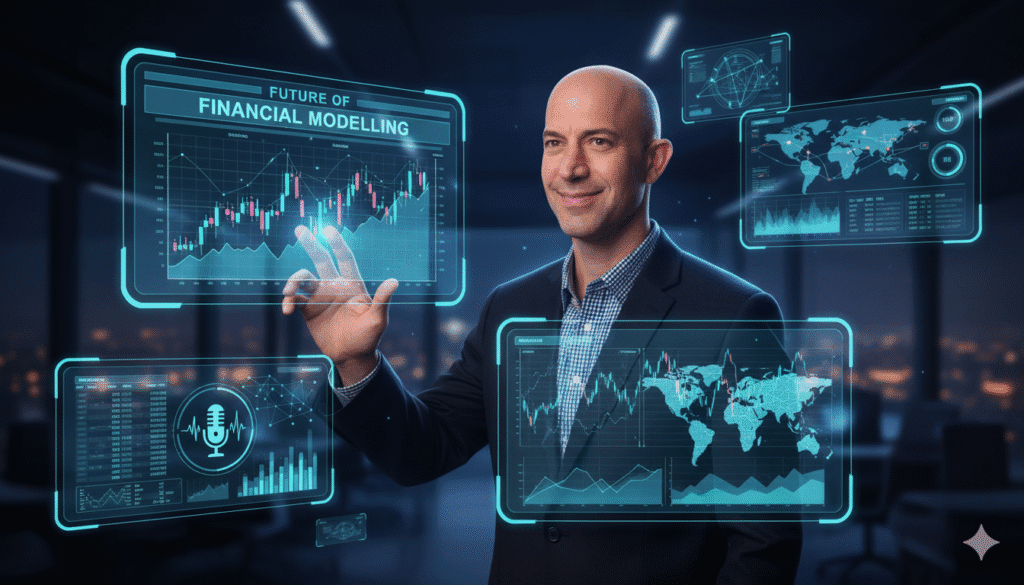
This comprehensive podcast episode features Lance Rubin, Founder of Model Citizn, in an in-depth conversation with host Heather Smith about the critical intersection of financial modeling, decision-making, and business survival strategies. Recorded during the early stages of the COVID-19 pandemic, this episode provides timely insights into how businesses can leverage data and financial modeling to navigate uncertainty and make informed decisions during crises.
The Journey from Chartered Accountant to Financial Modeling Expert, finding value in decision making
Lance’s professional journey from being a Chartered Accountant to a Cash Flow Financial Modeller reveals the evolution of modern accounting practices. After qualifying as a chartered accountant in South Africa and working for PWC in banking and financial services, Lance discovered his passion for financial modeling while auditing an actuary’s model. This pivotal moment led him to realise how financial engineering could create value in ways that traditional accounting couldn’t capture.
Lance emigrated to Australia 18 years ago and continued his career with PWC before joining Investec Bank in their corporate finance and M&A team, where financial modeling is extensively used for IPOs, project finance, capital raising, and unlisted trusts. This experience in investment banking provided the foundation for his expertise in sophisticated financial modeling techniques that he later brought to the broader business community.
Defining the Modern Financial Modeling Professional combining the art and science of finding value
Lance describes himself as a cash flow financial modeler, a finance innovator of data and a finance business technologist, reflecting the multidimensional nature of modern financial professionals. His company, Model Citizn, operates with a clear mission: to help businesses simplify complexity by making relevant, informed and purposeful decisions with insight. This philosophy, summarised by the acronym “RIP” (Relevant, Informed, Purposeful), emphasises that decision-making is the ultimate goal of all financial modeling efforts.
The episode explores how financial modeling has evolved beyond traditional spreadsheet work to encompass data analytics, visualisation, and technology integration. Lance’s role as a “finance business technologist” highlights the increasing importance of understanding both financial principles and emerging technologies in today’s business environment.
The Art and Science of Simple Financial Modeling and decision making
When asked to describe a simple financial modeling problem, Lance uses the example of a startup that has a great story and vision but doesn’t know how to translate that strategy into numbers. This scenario illustrates a fundamental challenge many businesses face: bridging the gap between strategic vision and financial reality.
Lance’s approach to financial modeling and the art and science of finding value follows a structured three-phase process. The first phase is scoping, where significant time is spent understanding not just what the client thinks they need, but why they need it and what decisions they’re trying to make. This phase often begins with a simple Word document rather than jumping straight into Excel, emphasising the importance of understanding the business model before building the financial model.
The development phase follows, where the actual model is built, similar to constructing a house with proper foundations and plans. Finally, the implementation phase involves training clients to use the model themselves, ensuring they can maintain and update it independently.
Technology Stack for Modern Financial Modeling
The episode provides valuable insights into the technology tools that assist in the art and science of finding value and that power modern financial modeling and data analytics. Lance organises his technology stack into three buckets: automation tools (like Calendly and DataDear), analytics tools (primarily Power BI for data visualisation and Azure Machine Learning for advanced predictive modeling), and financial modeling tools (particularly Modano, an Excel add-in that functions as a content management system for Excel).
Lance’s emphasis on Power BI reflects the growing importance of data visualization in financial modeling. Power BI, built by Microsoft, has significant development backing and serves as their go-to platform for analytics, with numerous add-ons and connectors being developed by the industry. The discussion also covers Modeller, a visualization tool that creates interactive dashboards, making financial models more accessible and engaging for decision-makers.
Crisis Management and COVID-19 Preparedness
Given the timing of this episode during the early COVID-19 pandemic, a significant portion focuses on how businesses can use financial modeling to prepare for uncertain times. Lance emphasises the critical importance of understanding cash runway – if a business has no revenue for the next three, six, or twelve months, how quickly will they run out of cash?
The episode provides practical advice: “We’re going to run out of cash in five months time. So what do we do to avoid that situation? Because if we have to go into liquidation and start up again, that’s a lot of pain. Staff are going to lose our jobs. We’re going to lose our company.” This stark reality check demonstrates the power of financial modeling in crisis planning.
Lance advocates for proactive scenario planning, considering various cost-cutting measures and their timeline impacts. This might include reducing staff, renegotiating leases, postponing capital expenditures, or implementing other strategic spending decisions to extend the business’s cash runway.
The Philosophy of Decision-Making in Uncertainty whilst still balancing the art and science of finding value
One of the episode’s most profound insights concerns why decision-making remains difficult despite access to vast amounts of data and sophisticated technology. Lance explains that “decisions are hard, because no one can predict the future. If everyone could predict the future, then decisions would be easy”.
However, financial modeling provides value not by predicting the future with certainty, but by offering a range of potential outcomes and their financial implications. Lance emphasises that “a financial model doesn’t give you the answer. It gives you a range of answers”, allowing decision-makers to feel more comfortable knowing they’ve explored various scenarios and understand the potential magnitude of different choices.
Building Advisory Capabilities for Accounting Professionals
The episode addresses a common challenge facing accounting professionals: the transition from compliance-focused services to advisory roles. Lance acknowledges that many accountants are hesitant to move into advisory services because, unlike tax and compliance, which are “binary” and “black or white,” advisory work involves uncertainty and multiple variables.
The key insight is that accountants don’t need to provide definitive answers in advisory roles. Instead, they should focus on giving clients the tools to make informed decisions themselves, helping them understand the financial implications of different choices without imposing their own views.
Dashboard Design and Data Visualisation Best Practices
The conversation includes practical guidance on creating effective dashboards and data visualisations. Lance emphasises the importance of understanding the story you’re trying to tell and focusing on key performance indicators rather than overwhelming users with too much information. He advocates for the strategic use of white space, clear labeling, high contrast colors, and the familiar red-amber-green traffic light system that everyone understands.
Career Development in Financial Modeling
For professionals interested in pursuing financial modeling careers, Lance recommends several practical steps. He highlights the “Spreadsheeting to Financial Modeling” series of articles published on LinkedIn, which represents the largest crowdsourced collection of financial modeling content globally. This series covers everything from basic formula writing to advanced topics like model auditing and scenario analysis.
The episode also discusses formal qualification pathways, including the Financial Modeling Institute (FMI) certifications, which require candidates to build complete three-way financial models under exam conditions without the aid of add-ins or automation tools.
The Human Side of Financial Modeling
Perhaps most memorably, the episode reveals Lance’s personal interests and how they inform his professional approach. His background in taekwondo, which he describes as a “scientific martial art” that uses mathematical principles and body mechanics, provides an interesting parallel to his analytical approach to financial modeling. Lance credits his martial arts training with developing resilience and stress management capabilities that serve him well in high-pressure business situations.
His unexpected passion for emojis on LinkedIn stems from a desire to make accounting and financial modeling more engaging and accessible, breaking the stereotype of boring accountants while maintaining professional credibility.
This episode serves as both an educational resource and an inspiration for finance professionals looking to expand their advisory capabilities, demonstrating how traditional accounting skills can evolve to meet modern business challenges through the strategic application of financial modeling, technology, and data-driven decision-making.